>
Gobiiformes (Gobies) >
Gobiidae (Gobies) > Gobionellinae
Etymology: Chaeturichthys: Greek, chaite = hair + Greek, oura = tail + Greek, ichthys = fish (Ref. 45335); jeoni: Named for Sang-Rin Jeon, Professor Emeritus of Sang Myung University, Seoul.
Eponymy: Dr Sang-Rin Jeon is a biologist who is Professor Emeritus at the Faculty of Natural Science, Sang Myung University, Seoul, South Korea. [...] (Ref. 128868), visit book page.
Environnement : milieu / zone climatique / profondeur / gamme de distribution
Écologie
marin démersal; profondeur 11 - 110 m (Ref. 93271), usually 43 - 85 m (Ref. 93271). Subtropical
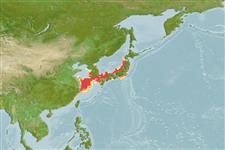
Western Pacific: Bohai Sea to East and South China seas.
Taille / Poids / Âge
Maturité: Lm ? range ? - ? cm
Max length : 22.0 cm SL mâle / non sexé; (Ref. 93271)
Description synthétique
Clés d'identification | Morphologie | Morphométrie
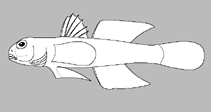
Épines dorsales (Total) : 8 - 10; Rayons mous dorsaux (Total) : 20 - 22; Épines anales: 1; Rayons mous anaux: 18 - 20. This species is distinguished from its only congener, C. stigmatias, by having the following characters: interorbital space scaleless (vs. embedded scales); usually 4 pairs of barbels on ventral surface of head, with 3 pairs of long barbels and a pair of short one (vs. usually 3 pairs of long barbels only); pectoral-fin rays 22-25, modally 24 (vs. 21-23, modally 22); most of pectoral-fin rays are branched, not forming free rays (vs. ventral 3-5 rays of pectoral fin simple, forming free rays); longitudinal scale rows 50-58 (vs. 47-53); transverse scale rows 20-25 (vs. 17-21); predorsal scales 23-29 (vs. 20-22); gill rakers on outer surface of first gill arch 2-6?9-13?12-16 (vs. 4-6 + 11-14 ? 16-19); pseudobranchial filaments 7-13, usually 9-11 (vs. 6-8, usually 7); preopercular canal with pores M' and N' (vs. only with pore N'); longer snout, its length 7.7-10.0% of SL (vs. 6.1-8.1% of SL) (Ref. 93271).
Body shape (shape guide): elongated.
Collected from the continental shelf of East Asia between the Bohai Sea and South China Sea (Ref. 93271).
Cycle de vie et comportement reproducteur
Maturité | Reproduction | Frai | Œufs | Fécondité | Larves
Shibukawa, K. and A. Iwata, 2013. Review of the East Asian gobiid genus Chaeturichthhys (Teleostei: Perciformes: Gobioidei), with description of a new species. Bull. Nat. Mus. Nat. Sci. Ser. A., Suppl. 7:53-66. (Ref. 93271)
Statut dans la liste rouge de l'IUCN (Ref. 130435: Version 2025-2 (Global))
Menace pour l'homme
Harmless
Utilisations par l'homme
Outils
Articles particuliers
Télécharger en XML
Sources Internet
Estimations basées sur des modèles
Température préférée (Réf.
123201): 8.6 - 21.9, mean 16.8 °C (based on 70 cells).
Indice de diversité phylogénétique (Réf.
82804): PD
50 = 0.7500 [Uniqueness, from 0.5 = low to 2.0 = high].
Bayesian length-weight: a=0.00708 (0.00332 - 0.01511), b=3.07 (2.89 - 3.25), in cm total length, based on LWR estimates for this (Sub)family-body shape (Ref.
93245).
Niveau trophique (Réf.
69278): 3.6 ±0.5 se; based on size and trophs of closest relatives
Résilience (Réf.
120179): Milieu, temps minimum de doublement de population : 1,4 à 4,4 années (Preliminary K or Fecundity.).
Vulnérabilité de la pêche (Ref.
59153): Low vulnerability (17 of 100).
🛈