Klassifizierung / Names
Namen | Synonyme | Catalog of Fishes(Gattung, Arten) | ITIS | CoL | WoRMS | Cloffa
>
Cichliformes (Cichlids, convict blennies) >
Cichlidae (Cichlids) > Pseudocrenilabrinae
Etymology: Protomelas: Greek, protos = the first + Greek, melas, melanos = black (Ref. 45335); krampus: The specific name, 'krampus', is a noun in apposition and was chosen in reference to the European folklore character Krampus; this demon puts naughty children in a bag and takes them away, which is reminiscent of a paedophagous behaviour; the goat-like appearance of Krampus also implicitly refers to the head-butting behaviour of this species; the same implicit reference to this behaviour is also found in the genus name Caprichromis of other paedophagous species of Lake Malawi (Ref. 122325).
Umwelt: Milieu / Klimazone / Tiefenbereich / Verbreitungsgebiet
Ökologie
; süßwasser benthopelagisch. Tropical
Africa: Lake Malawi (Ref. 122325).
Größe / Gewicht / Alter
Geschlechtsreife: Lm ? range ? - ? cm
Max length : 18.1 cm SL Männchen/unbestimmt; (Ref. 122325)
Kurzbeschreibung
Bestimmungsschlüssel | Morphologie | Morphometrie
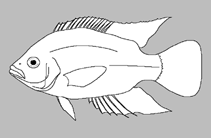
Rückenflossenstacheln (insgesamt) : 17; Rückenflossenweichstrahlen (insgesamt) : 11 - 12; Afterflossenweichstrahlen: 9 - 10; Wirbelzahl: 31 - 32. Diagnosis: Protomelas krampus differs from most species of Protomelas, i.e. P. annectens, P. fenestratus, P. kirkii, P. labridens, P. macrodon, P. marginatus, P. pleurotaenia, P. similis, P. spilonotus, P. taeniolatus, P. triaenodon and P. virgatus, by having only one inner tooth row, whereas the other species have two rows (Ref. 122325). It can be distinguished from P. spilopterus by a shorter premaxillary pedicel, 17.0-19.2% of head length vs. 21.8-28.4%; a larger gape inclination, 70-80° vs. 40-60°; a shallower body, 33.3-34.3% of standard length vs. 36.0-42.8%; a smaller predorsal distance, 27.4-29.1% of standard length vs. 33.4-37.4%; a smaller prepectoral distance, 29.4-29.8% of standard length vs. 31.8-40.0%; a shorter and more slender head, its length 27.8-29.2% of standard length vs. 30.4-34.6%, and width 39.3-40.3% of head length vs. 41.4-50.7%; and a smaller interorbital width, 22.9-23.4% of head length vs. 25.0-33.6%; in addition, it has more gill rakers on the outer epibranchial than P. spilopterus, 5 vs. 3-4, and more vertebrae, 31-32 vs. 29; the inner teeth are tricuspid in P. krampus while mixed unicuspid/tricuspid or unicuspid in P. spilopterus; the outer teeth of the lower jaw of P. krampus are oriented straight up, whereas those of P. spilopterus are angled forward (Ref. 122325). It differs from P. insignis by a shorter premaxillary pedicel, 17.0-19.2% of head length vs. 27.9-30.0%; a deeper cheek, 31.6-40.2% of head length vs. 23.2-28.5%; the larger gape inclination, 70-80° vs. 30°; a smaller predorsal distance, 27.4-29.1% of standard length vs. 34.2-35.9%; a smaller prepectoral distance, 29.4-29.8% of standard length vs. 32.7-35.4%; a shorter and more slender head, its length 27.8-29.2% of standard length vs. 31.6-34.3%, and width 39.3-40.3% of head length vs. 41.3-44.8%; a shallower lacrimal, 19.6-20.4% of head length vs. 21.4-22.4%; a smaller interorbital width, 22.9-23.4% of head length vs. 26.9-32.8%; and a longer lower jaw, 37.7-38.8% of head length vs. 31.2-37.3%; the upper jaw has fewer outer teeth in P. krampus than in P. insignis, 37-40 vs. 43-50; outer lower jaw teeth are straight in P. krampus but curved inwards in P. insignis (Ref. 122325). It differs from both species of the genus Hemitaeniochromis by its continuous midlateral stripe, which places it in Protomelas, whereas H. urotaenia and H. brachyrhynchus have an anteriorly spotted stripe (Ref. 122325). It differs from the paedophagous species of the genus Caprichromis by its melanin pattern: it has a midlateral band from behind the opercle to the base of the caudal fin, whereas species of Caprichromis have a diagonal stripe from the nape to the base of the caudal fin (Ref. 122325). It differs from Diplotaxodon greenwoodi by the lack of a melanin pattern in the latter species; it has isognathous jaws, whereas D. greenwoodi has a protruding lower jaw (Ref. 122325). Protomelas krampus differs from Naevochromis chrysogaster by its melanin pattern, which consists of three large spots on the lateral sides in the latter instead of a continuous midlateral line; it has a more strongly inclined gape than N. chrysogaster; and it has only one inner tooth row on the lower jaw, whereas N. chrysogaster has two (Ref. 122325).
Body shape (shape guide): fusiform / normal.
This species is observed feeding on eggs and fry while stealing them from mouth-brooding females of other cichlid species; the paedophage rams these females from above on the snout and the brooding females may release some eggs or larvae upon this impact; the brood can then be snatched by Protomelas krampus (Ref. 122325). The inclined position of the mouth enables the fish to immediately grab the brood since it is already in a good position relative to the prey after ramming from above (Ref. 122325).
Lebenszyklus und Paarungsverhalten
Geschlechtsreife | Fortpflanzung | Ablaichen | Eier | Fruchtbarkeit | Larven
Dierickx, K. and J. Snoeks, 2020. Protomelas krampus, a new paedophagous cichlid from Lake Malawi (Teleostei, Cichlidae). Eur. J. Taxon. 672:1-18. (Ref. 122325)
IUCN Rote Liste Status (Ref. 130435: Version 2025-2 (Global))
Bedrohung für Menschen
Harmless
Nutzung durch Menschen
Tools
Zusatzinformationen
Download XML
Internet Quellen
Schätzungen auf der Grundlage von Modellen
Phylogenetischer Diversitätsindex (Ref.
82804): PD
50 = 0.5000 [Uniqueness, from 0.5 = low to 2.0 = high].
Bayesian length-weight: a=0.00389 (0.00180 - 0.00842), b=3.12 (2.94 - 3.30), in cm total length, based on all LWR estimates for this body shape (Ref.
93245).
Trophische Ebene (Ref.
69278): 3.3 ±0.4 se; based on size and trophs of closest relatives
Widerstandsfähigkeit (Ref.
120179): hoch, Verdopplung der Population dauert weniger als 15 Monate. (Preliminary K or Fecundity.).
Anfälligkeit der Fischerei (Ref.
59153): Low vulnerability (12 of 100).
🛈