>
Siluriformes (Catfishes) >
Malapteruridae (Electric catfishes)
Etymology: Malapterurus: Greek, mala = a lot of + Greek, pteron = fin + Greek, oura = tail (Ref. 45335); electricus: The electric discharging capacity of this electric catfish is described by the specific epithet (Ref. 44050).
More on author: Gmelin.
Окружающая среда: среда / климатическая зона / пределы глубины / диапазон распространения
экология
; пресноводный донно-пелагический; pH range: 7.0 - 8.0; dH range: ? - 20; мигрирует в реке (Ref. 51243). Tropical; 23°C - 30°C (Ref. 1672); 35°N - 30°S
Africa: typical Sudanian distribution; in much of the Nile system (exclusive of Lake Victoria), Lake Turkana, Lake Chad and Senegal basins, throughout the Niger system and smaller southward flowing basins in west Africa, from Bandama through Volta rivers in Ivory Coast and Ghana (Ref. 44050). Absent from Congo basin; reports from Congo basin refer to any of the other species in this system (see Ref. 44050 for details).
Размер / Вес / Возраст
половая зрелость: Lm ? range ? - ? cm
Max length : 122 cm SL самец/пол неопределен; (Ref. 3850); наибольший вес (опубликованные данные): 20.0 kg (Ref. 3799); наибольший возраст (опубликованны данные): 10 годы (Ref. 7248)
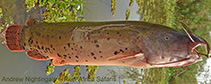
колючие лучи спинного плавника (общее число) : 0; членистые (мягкие) лучи спинного плавника (общее число) : 0; колючие лучи анального плавника: 0; членистые (мягкие) лучи анального плавника: 9 - 11; позвонки: 38 - 41. Diagnosis: tooth patches narrow; pectoral fin placed near body mid-depth; 7-8 branched caudal fin rays (Ref. 44050). 9-11 anal-fin rays, usually 10-11; 38-41 total vertebrae, usually 39-41 (Ref. 57130). Caudal saddle and bar pattern not present in adults (Ref. 57130), poorly developed in all ages (Ref. 44050). Flank and dorsum in adults and young marked with large blotches (some up to 4-5 times eye diameter); caudal fin of adults generally same color as flank ground color or slightly darker, larger specimens usually with spots or blotches in caudal fin (Ref. 44050, 57130).
Body shape (shape guide): fusiform / normal; Cross section: circular.
Occur among rocks or roots. Favors sluggish or standing water. Active at night, feeding mainly on fish stunned by electric shocks. Described as a nocturnal piscivore that breeds during periods of high water; rarely feeds on molluscs (Ref. 44050). The electric organ, capable of discharging 300-400 V, is derived from pectoral muscle and surrounds almost the entire body. It is used both for prey capture and defense. Electric organ discharge (EOD) is intermittent and the amplitude increases with size of the fish (Ref. 10011). Responds immediately to cyclic light changes, exhibiting maximum EOD activity shortly after sunset and lowest activity just after sunrise (Ref. 10798). Its EOD duration decreased from 1.5 to 0.3 ms in response to increased temperature from 15 to 30°C (Ref. 10838). Adults form pairs and breed in excavated cavities or holes (Ref. 7248). Maximum size in Lake Chad reported as 1125mm SL, but most museum specimens much smaller (maximum 400mm SL, Nile River)(Ref. 57130).
Жизненный цикл и брачное поведение
половая зрелость | размножение | нерест | икра | Плодовитость | личинки
It is assumed that the male tends the clutch. Others report that the male takes the eggs into his mouth. It is also unknown how the fry is immune to the electric shocks by the parents (Ref. 1672).
Roberts, T.R., 2000. A review of the African electric catfish family Malapteruridae, with descriptions of new species. Occas. Pap. Ichthyol. 1:1-15. (Ref. 34006)
Статус Красного Списка МСОП (Ref. 130435: Version 2025-2 (Global))
Использование человеком
рыболовство: рыболовство как средство для существования; объект спортивного рыболовства: да
дополнительная информация
инструменты
Специальные отчеты
Скачать в формате XML
ресурсы в Интернет
Оценки, основанные на моделях
Индекс филогенетического разнообразия (ссылка
82804): PD
50 = 0.5000 [Uniqueness, from 0.5 = low to 2.0 = high].
Bayesian length-weight: a=0.01202 (0.00883 - 0.01637), b=2.95 (2.86 - 3.04), in cm total length, based on LWR estimates for this species (Ref.
93245).
Трофический уровень (ссылка
69278): 2.9 ±0.38 se; based on food items.
устойчивость к внешним воздействиям (ссылка
120179): низкий, минимальное время удвоения популяции 4.5-14 лет (tmax=10; Fec < 1,000).
Уязвимость рыбной ловли (Ref.
59153): Very high vulnerability (89 of 100).
🛈
Питательные вещества (Ref.
124155): Calcium = 48.9 [27.2, 92.2] mg/100g; Iron = 1.14 [0.65, 2.02] mg/100g; Protein = 16.4 [15.2, 17.6] %; Omega3 = 0.382 [0.141, 1.050] g/100g; Selenium = 119 [46, 264] μg/100g; VitaminA = 34.3 [11.4, 99.9] μg/100g; Zinc = 1.24 [0.82, 1.79] mg/100g (wet weight);