>
Siluriformes (Catfishes) >
Malapteruridae (Electric catfishes)
Etymology: Malapterurus: Greek, mala = a lot of + Greek, pteron = fin + Greek, oura = tail (Ref. 45335); electricus: The electric discharging capacity of this electric catfish is described by the specific epithet (Ref. 44050).
More on author: Gmelin.
Entorno: milieu / zona climática / rango de profundidad / gama de distribución
Ecología
; agua dulce bentopelágico; pH range: 7.0 - 8.0; dH range: ? - 20; potamodromo (Ref. 51243). Tropical; 23°C - 30°C (Ref. 1672); 35°N - 30°S
Africa: typical Sudanian distribution; in much of the Nile system (exclusive of Lake Victoria), Lake Turkana, Lake Chad and Senegal basins, throughout the Niger system and smaller southward flowing basins in west Africa, from Bandama through Volta rivers in Ivory Coast and Ghana (Ref. 44050). Absent from Congo basin; reports from Congo basin refer to any of the other species in this system (see Ref. 44050 for details).
Tamaño / Peso / Edad
Madurez: Lm ? range ? - ? cm
Max length : 122 cm SL macho / no sexado; (Ref. 3850); peso máximo publicado: 20.0 kg (Ref. 3799); edad máxima reportada: 10 años (Ref. 7248)
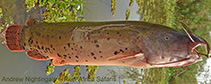
Espinas dorsales (total) : 0; Radios blandos dorsales (total) : 0; Espinas anales: 0; Radios blandos anales: 9 - 11; Vértebra: 38 - 41. Diagnosis: tooth patches narrow; pectoral fin placed near body mid-depth; 7-8 branched caudal fin rays (Ref. 44050). 9-11 anal-fin rays, usually 10-11; 38-41 total vertebrae, usually 39-41 (Ref. 57130). Caudal saddle and bar pattern not present in adults (Ref. 57130), poorly developed in all ages (Ref. 44050). Flank and dorsum in adults and young marked with large blotches (some up to 4-5 times eye diameter); caudal fin of adults generally same color as flank ground color or slightly darker, larger specimens usually with spots or blotches in caudal fin (Ref. 44050, 57130).
Body shape (shape guide): fusiform / normal; Cross section: circular.
Occur among rocks or roots. Favors sluggish or standing water. Active at night, feeding mainly on fish stunned by electric shocks. Described as a nocturnal piscivore that breeds during periods of high water; rarely feeds on molluscs (Ref. 44050). The electric organ, capable of discharging 300-400 V, is derived from pectoral muscle and surrounds almost the entire body. It is used both for prey capture and defense. Electric organ discharge (EOD) is intermittent and the amplitude increases with size of the fish (Ref. 10011). Responds immediately to cyclic light changes, exhibiting maximum EOD activity shortly after sunset and lowest activity just after sunrise (Ref. 10798). Its EOD duration decreased from 1.5 to 0.3 ms in response to increased temperature from 15 to 30°C (Ref. 10838). Adults form pairs and breed in excavated cavities or holes (Ref. 7248). Maximum size in Lake Chad reported as 1125mm SL, but most museum specimens much smaller (maximum 400mm SL, Nile River)(Ref. 57130).
Ciclo vital y comportamiento de apareamiento
Madurez | Reproducción | Puesta | Huevos | Fecundidad | Larva
It is assumed that the male tends the clutch. Others report that the male takes the eggs into his mouth. It is also unknown how the fry is immune to the electric shocks by the parents (Ref. 1672).
Roberts, T.R., 2000. A review of the African electric catfish family Malapteruridae, with descriptions of new species. Occas. Pap. Ichthyol. 1:1-15. (Ref. 34006)
Situación en la Lista Roja de la UICN (Ref. 130435: Version 2025-2 (Global))
Amenaza para el ser humano
Usos humanos
Pesquerías: pesquerías de subsistencia; pesca deportiva: si
Herramientas
Informes especiales
Descargar XML
Fuentes de Internet
Estimaciones basadas en modelos
Índice de diversidad filogenética (Referencia
82804): PD
50 = 0.5000 [Uniqueness, from 0.5 = low to 2.0 = high].
Bayesian length-weight: a=0.01202 (0.00883 - 0.01637), b=2.95 (2.86 - 3.04), in cm total length, based on LWR estimates for this species (Ref.
93245).
Nivel trófico (Referencia
69278): 2.9 ±0.38 se; based on food items.
Resiliencia (Referencia
120179): Bajo, población duplicada en un tiempo mínimo de 4.5-14 años (tmax=10; Fec < 1,000).
Vulnerabilidad pesquera (Ref.
59153): Very high vulnerability (89 of 100).
🛈
Nutrientes (Ref.
124155): Calcium = 48.9 [27.2, 92.2] mg/100g; Iron = 1.14 [0.65, 2.02] mg/100g; Protein = 16.4 [15.2, 17.6] %; Omega3 = 0.382 [0.141, 1.050] g/100g; Selenium = 119 [46, 264] μg/100g; VitaminA = 34.3 [11.4, 99.9] μg/100g; Zinc = 1.24 [0.82, 1.79] mg/100g (wet weight);