>
Ovalentaria/misc (Various families in series Ovalentaria) >
Pomacentridae (Damselfishes) > Glyphisodontinae
Etymology: Abudefduf: Arabic, abu = father; this fish is the leader of the reef against other species (Ref. 45335).
More on authors: Müller & Troschel.
Môi trường: môi trường / vùng khí hậu / Mức độ sâu / phạm vi phân phối
Sinh thái học
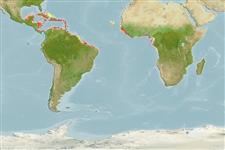
biển cùng sống ở rạn san hô; không di cư; mức độ sâu 1 - 5 m (Ref. 9710). Subtropical; 24°N - 7°S, 133°W - 62°E (Ref. 56030)
Western Atlantic: southern Florida, USA and the Caribbean Sea. Reported from northern South America (Ref. 5217). Eastern Atlantic: Cape Verde and from Senegal to Angola.
Bộ gần gũi / Khối lượng (Trọng lượng) / Tuổi
Chín muồi sinh dục: Lm ? range ? - ? cm
Max length : 25.0 cm TL con đực/không giới tính; (Ref. 7251); common length : 20.0 cm SL con đực/không giới tính; (Ref. 3139)
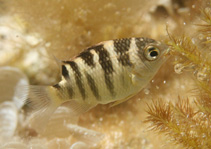
Các tia vây lưng cứng (tổng cộng) : 13; Các vây lưng mềm (tổng cộng) : 11 - 12; Tia cứng vây hậu môn: 2; Tia mềm vây hậu môn: 10. Caudal fin lobe rounded (Ref. 7247). A heavy-bodied, compressed species; tawny yellow above, paler below, with 5 or 6 dark bars wider than interspaces between them (Ref. 26938). A sixth faint bar or dark saddle-like mark may be present on upper part of caudal peduncle; a prominent black spot at upper base of pectoral fin (Ref. 13442).
Body shape (shape guide): short and / or deep; Cross section: compressed.
Adults inhabit rocky inshore reefs. They prefer wave-cut rock ledges or limestone shorelines and tide pools in regions with surf. Feed mainly on algae but adults also consume Zoanthus and hydroids while juveniles also feed on copepods (Ref. 9626). Oviparous, distinct pairing during breeding (Ref. 205). Eggs are demersal and adhere to the substrate (Ref. 205). Males guard and aerate the eggs (Ref. 205). Marketed fresh (Ref. 3139).
Vòng đời và hành vi giao phối
Chín muồi sinh dục | Sự tái sinh sản | Đẻ trứng | Các trứng | Sự sinh sản | Ấu trùng
Oviparous, distinct pairing during breeding (Ref. 205). Eggs are demersal and adhere to the substrate (Ref. 205). Males guard and aerate the eggs (Ref. 205).
Allen, G.R., 1991. Damselfishes of the world. Mergus Publishers, Melle, Germany. 271 p. (Ref. 7247)
Tình trạng Sách đỏ IUCN (Ref. 130435: Version 2025-2 (Global))
Mối đe dọa đối với con người
Harmless
Sử dụng của con người
Các nghề cá: buôn bán nhỏ
Các công cụ
Báo cáo đặc biệt
Tải xuống XML
Các nguồn internet
Ước tính dựa trên mô hình
Nhiệt độ ưa thích (Tài liệu tham khảo
123201): 26.3 - 28.2, mean 27.5 °C (based on 581 cells).
Chỉ số đa dạng phát sinh loài (Tài liệu tham khảo
82804): PD
50 = 0.5000 [Uniqueness, from 0.5 = low to 2.0 = high].
Bayesian length-weight: a=0.02239 (0.00963 - 0.05206), b=3.06 (2.87 - 3.25), in cm total length, based on LWR estimates for this Genus-body shape (Ref.
93245).
Mức dinh dưỡng (Tài liệu tham khảo
69278): 2.1 ±0.1 se; based on diet studies.
Thích nghi nhanh (Tài liệu tham khảo
120179): Trung bình, thời gian nhân đôi của chủng quần tối thiểu là 1.4 - 4.4 năm (Preliminary K or Fecundity.).
Sự dễ bị tổn thương của nghề đánh cá (Ref.
59153): Low vulnerability (15 of 100).
🛈
Chất dinh dưỡng (Ref.
124155): Calcium = 49.7 [20.2, 82.2] mg/100g; Iron = 0.637 [0.346, 1.194] mg/100g; Protein = 18.9 [17.5, 20.2] %; Omega3 = 0.116 [0.060, 0.226] g/100g; Selenium = 9.57 [4.07, 22.63] μg/100g; VitaminA = 37.5 [8.0, 169.1] μg/100g; Zinc = 1.12 [0.69, 1.88] mg/100g (wet weight);