>
Ovalentaria/misc (Various families in series Ovalentaria) >
Pomacentridae (Damselfishes) > Glyphisodontinae
Etymology: Abudefduf: Arabic, abu = father; this fish is the leader of the reef against other species (Ref. 45335).
More on authors: Müller & Troschel.
Окружающая среда: среда / климатическая зона / пределы глубины / диапазон распространения
экология
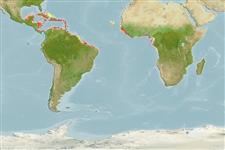
морской ассоциированный с рифами; немигрирующий; пределы глубины 1 - 5 m (Ref. 9710). Subtropical; 24°N - 7°S, 133°W - 62°E (Ref. 56030)
Western Atlantic: southern Florida, USA and the Caribbean Sea. Reported from northern South America (Ref. 5217). Eastern Atlantic: Cape Verde and from Senegal to Angola.
Размер / Вес / Возраст
половая зрелость: Lm ? range ? - ? cm
Max length : 25.0 cm TL самец/пол неопределен; (Ref. 7251); common length : 20.0 cm SL самец/пол неопределен; (Ref. 3139)
Краткое описание
определительные ключи | морфология | морфометрия
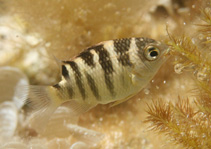
колючие лучи спинного плавника (общее число) : 13; членистые (мягкие) лучи спинного плавника (общее число) : 11 - 12; колючие лучи анального плавника: 2; членистые (мягкие) лучи анального плавника: 10. Caudal fin lobe rounded (Ref. 7247). A heavy-bodied, compressed species; tawny yellow above, paler below, with 5 or 6 dark bars wider than interspaces between them (Ref. 26938). A sixth faint bar or dark saddle-like mark may be present on upper part of caudal peduncle; a prominent black spot at upper base of pectoral fin (Ref. 13442).
Body shape (shape guide): short and / or deep; Cross section: compressed.
Adults inhabit rocky inshore reefs. They prefer wave-cut rock ledges or limestone shorelines and tide pools in regions with surf. Feed mainly on algae but adults also consume Zoanthus and hydroids while juveniles also feed on copepods (Ref. 9626). Oviparous, distinct pairing during breeding (Ref. 205). Eggs are demersal and adhere to the substrate (Ref. 205). Males guard and aerate the eggs (Ref. 205). Marketed fresh (Ref. 3139).
Жизненный цикл и брачное поведение
половая зрелость | размножение | нерест | икра | Плодовитость | личинки
Oviparous, distinct pairing during breeding (Ref. 205). Eggs are demersal and adhere to the substrate (Ref. 205). Males guard and aerate the eggs (Ref. 205).
Allen, G.R., 1991. Damselfishes of the world. Mergus Publishers, Melle, Germany. 271 p. (Ref. 7247)
Статус Красного Списка МСОП (Ref. 130435: Version 2025-2 (Global))
Угроза для людей
Harmless
Использование человеком
рыболовство: не имеет хозяйственного значения
дополнительная информация
инструменты
Специальные отчеты
Скачать в формате XML
ресурсы в Интернет
Оценки, основанные на моделях
Предпочтительная температура (ссылка
123201): 26.3 - 28.2, mean 27.5 °C (based on 581 cells).
Индекс филогенетического разнообразия (ссылка
82804): PD
50 = 0.5000 [Uniqueness, from 0.5 = low to 2.0 = high].
Bayesian length-weight: a=0.02239 (0.00963 - 0.05206), b=3.06 (2.87 - 3.25), in cm total length, based on LWR estimates for this Genus-body shape (Ref.
93245).
Трофический уровень (ссылка
69278): 2.1 ±0.1 se; based on diet studies.
устойчивость к внешним воздействиям (ссылка
120179): средний (среднего размера), минимальное время удвоения популяции 1.4-4.4 года (Preliminary K or Fecundity.).
Уязвимость рыбной ловли (Ref.
59153): Low vulnerability (15 of 100).
🛈
Питательные вещества (Ref.
124155): Calcium = 49.7 [20.2, 82.2] mg/100g; Iron = 0.637 [0.346, 1.194] mg/100g; Protein = 18.9 [17.5, 20.2] %; Omega3 = 0.116 [0.060, 0.226] g/100g; Selenium = 9.57 [4.07, 22.63] μg/100g; VitaminA = 37.5 [8.0, 169.1] μg/100g; Zinc = 1.12 [0.69, 1.88] mg/100g (wet weight);