>
Perciformes/Zoarcoidei (Eelpouts and pricklebacks) >
Anarhichadidae (Wolffishes)
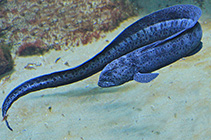
Etymology: Anarrhichthys: Greek, anarhichaomai = to climb up + Greek, ichthys = fish; ocellatus: ocellatus for the eye-like spots.
More on author: Ayres.
Ambiente: milieu / zona climatica / distribuzione batimetrica / gamma di distribuzione
Ecologia
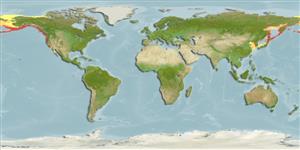
marino demersale; distribuzione batimetrica 1 - 226 m (Ref. 2850). Temperate; 80°N - 26°N, 117°E - 111°W (Ref. 57366)
North Pacific: Sea of Okhotsk and the Sea of Japan to the Krenitzen Islands, in the Aleutian chain and Imperial Beach, southern California, USA.
Dimensione / Peso / Età
Maturità: Lm ? range ? - ? cm
Max length : 240 cm TL maschio/sesso non determinato; (Ref. 4925); peso massimo pubblicato: 18.4 kg (Ref. 27436)
Breve descrizione
Chiavi di identificazione | Morfologia | Morfometria
Spine anali: 0; Raggi anali molli: 200. Dorsal with 228-250 spines. Caudal small. Anal with up to 233 rays.
Body shape (shape guide): elongated.
Adults seek shelter among rocks in subtidal areas (Ref. 2850) and will occupy the same shelter until driven out by larger wolf-eels or a large octopus (Ref. 28499). Juveniles are pelagic for up to two years (Ref. 28499). Feed on hard-shelled invertebrates and fishes (Ref. 2850). Both male and female wrap their body around the egg mass to keep the eggs in place and to deter predators (Ref. 58332). Large specimens can inflict a painful bite (Ref. 28499). Its flesh is tasty (Ref. 28499).
Ciclo vitale e comportamento di accoppiamento
Maturità | Riproduzione | Deposizione | Uova | Fecondità | Larve
When courting, the male wolf-eel butts his head against the female's abdomen, wraps around her, and fertilizes her eggs as she extrudes them. Eggs are laid and both male and female wrap themselves around the egg mass to protect it . Only one parent at a time leaves the eggs to feed. The female periodically rotates the eggs until they hatch. A male and female may pair for life (Ref. 28499).
Eschmeyer, W.N., E.S. Herald and H. Hammann, 1983. A field guide to Pacific coast fishes of North America. Boston (MA, USA): Houghton Mifflin Company. xii+336 p. (Ref. 2850)
Stato della Lista Rossa IUCN (Ref. 130435: Version 2025-2 (Global))
Minaccia per l'uomo
Traumatogenic (Ref. 2850)
Usi umani
Pesca: scarso interesse commerciale; Acquario: Acquari pubblici
Strumenti
Rapporti speciali
Scarica XML
Fonti Internet
Stime basate su modelli
Temperatura preferita (Fonte Biblio.
123201): 1.2 - 10.5, mean 4.7 °C (based on 485 cells).
Indice di diversità filogenetica (Fonte Biblio.
82804): PD
50 = 1.0312 [Uniqueness, from 0.5 = low to 2.0 = high].
Bayesian length-weight: a=0.00407 (0.00180 - 0.00922), b=3.16 (2.96 - 3.36), in cm total length, based on LWR estimates for this (Sub)family-body shape (Ref.
93245).
Livello trofico (Fonte Biblio.
69278): 3.5 ±0.53 se; based on food items.
Resilienza (Fonte Biblio.
120179): Basso, tempo minimo di raddoppiamento della popolazione 4.5 - 14 anni (tm=7; Fec=10,000).
Vulnerabilità della pesca (Ref.
59153): Very high vulnerability (90 of 100).
🛈
Nutrienti (Ref.
124155): Calcium = 12.2 [6.7, 26.3] mg/100g; Iron = 0.23 [0.12, 0.46] mg/100g; Protein = 17.9 [15.8, 19.8] %; Omega3 = 0.307 [0.169, 0.537] g/100g; Selenium = 27.5 [14.0, 56.6] μg/100g; VitaminA = 5.19 [1.56, 17.30] μg/100g; Zinc = 0.393 [0.268, 0.590] mg/100g (wet weight);