>
Perciformes/Zoarcoidei (Eelpouts and pricklebacks) >
Anarhichadidae (Wolffishes)
Etymology: Anarrhichthys: Greek, anarhichaomai = to climb up + Greek, ichthys = fish; ocellatus: ocellatus for the eye-like spots.
More on author: Ayres.
Περιβάλλον: περιβάλλον / κλιματική ζώνη / εύρος βάθους / εύρος διανομής
Οικολογία
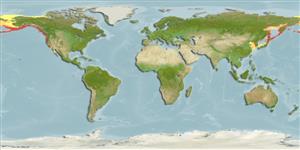
Θαλασσινό(ά) βενθικό(ς); εύρος βάθους 1 - 226 m (Ref. 2850). Temperate; 80°N - 26°N, 117°E - 111°W (Ref. 57366)
North Pacific: Sea of Okhotsk and the Sea of Japan to the Krenitzen Islands, in the Aleutian chain and Imperial Beach, southern California, USA.
Μέγεθος / Βάρος / Ηλικία
Γεννητική Ωρίμανση: Lm ? range ? - ? cm
Max length : 240 cm TL αρσενικό/απροσδιόριστο; (Ref. 4925); μεγ. δημοσιευμένο βάρος: 18.4 kg (Ref. 27436)
Σύντομη περιγραφή
Κλείδες προσδιορισμού | Μορφολογία | Μορφομετρία
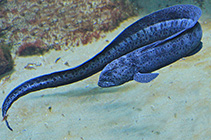
Εδρικές άκανθες: 0; Μαλακές εδρικές ακτίνες: 200. Dorsal with 228-250 spines. Caudal small. Anal with up to 233 rays.
Body shape (shape guide): elongated.
Adults seek shelter among rocks in subtidal areas (Ref. 2850) and will occupy the same shelter until driven out by larger wolf-eels or a large octopus (Ref. 28499). Juveniles are pelagic for up to two years (Ref. 28499). Feed on hard-shelled invertebrates and fishes (Ref. 2850). Both male and female wrap their body around the egg mass to keep the eggs in place and to deter predators (Ref. 58332). Large specimens can inflict a painful bite (Ref. 28499). Its flesh is tasty (Ref. 28499).
When courting, the male wolf-eel butts his head against the female's abdomen, wraps around her, and fertilizes her eggs as she extrudes them. Eggs are laid and both male and female wrap themselves around the egg mass to protect it . Only one parent at a time leaves the eggs to feed. The female periodically rotates the eggs until they hatch. A male and female may pair for life (Ref. 28499).
Eschmeyer, W.N., E.S. Herald and H. Hammann, 1983. A field guide to Pacific coast fishes of North America. Boston (MA, USA): Houghton Mifflin Company. xii+336 p. (Ref. 2850)
Κατάσταση Κόκκινου Καταλόγου IUCN (Ref. 130435: Version 2025-2 (Global))
Απειλή για τον άνθρωπο
Traumatogenic (Ref. 2850)
Ανθρώπινες χρήσεις
αλιεία: περιορισμένης εμπορικότητας; Ενυδρείο: Δημόσια ενυδρεία
Εργαλεία
Ειδικές εκθέσεις
Λήψη XML
Διαδικτυακές πηγές
Εκτιμήσεις βάσει μοντέλων
Προτιμώμενη θερμοκρασία (Αναφ.
123201): 1.2 - 10.5, mean 4.7 °C (based on 485 cells).
Δείκτης φυλογενετικής ποικιλότητας (Αναφ.
82804): PD
50 = 1.0312 [Uniqueness, from 0.5 = low to 2.0 = high].
Bayesian length-weight: a=0.00407 (0.00180 - 0.00922), b=3.16 (2.96 - 3.36), in cm total length, based on LWR estimates for this (Sub)family-body shape (Ref.
93245).
Τροφικό Επίπεδο (Αναφ.
69278): 3.5 ±0.53 se; based on food items.
Ελαστικότητα (Αναφ.
120179): Χαμηλό, ελάχιστος χρόνος για διπλασιασμό πληθυσμού 4,5 - 14 έτη (tm=7; Fec=10,000).
Ευπάθεια στην αλιεία (Ref.
59153): Very high vulnerability (90 of 100).
🛈
Θρεπτικά συστατικά (Ref.
124155): Calcium = 12.2 [6.7, 26.3] mg/100g; Iron = 0.23 [0.12, 0.46] mg/100g; Protein = 17.9 [15.8, 19.8] %; Omega3 = 0.307 [0.169, 0.537] g/100g; Selenium = 27.5 [14.0, 56.6] μg/100g; VitaminA = 5.19 [1.56, 17.30] μg/100g; Zinc = 0.393 [0.268, 0.590] mg/100g (wet weight);