>
Ovalentaria/misc (Various families in series Ovalentaria) >
Plesiopidae (Roundheads) > Plesiopinae
Etymology: Calloplesiops: Greek, kalos, kallos = beautiful + Greek, plesios = near, neighbour + Greek, ops = appearance (Ref. 45335).
More on author: Steindachner.
Môi trường: môi trường / vùng khí hậu / Mức độ sâu / phạm vi phân phối
Sinh thái học
biển cùng sống ở rạn san hô; mức độ sâu 3 - 110 m (Ref. 48635), usually 3 - 45 m (Ref. 27115). Tropical; 32°N - 24°S
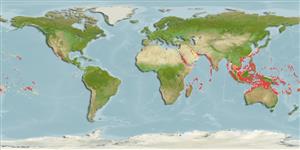
Indo-Pacific: Red Sea and East Africa to Tonga and the Line Islands.
Bộ gần gũi / Khối lượng (Trọng lượng) / Tuổi
Chín muồi sinh dục: Lm ? range ? - ? cm
Max length : 20.0 cm TL con đực/không giới tính; (Ref. 48635); Tuổi cực đại được báo cáo: 9 các năm
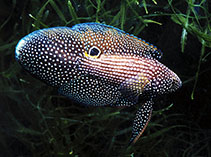
Các tia vây lưng cứng (tổng cộng) : 11; Các vây lưng mềm (tổng cộng) : 8 - 10; Tia cứng vây hậu môn: 3; Tia mềm vây hậu môn: 9. Characterized by having tubed lateral-line scales 19-20+9-10; depth of body 2.5-2.7 in SL; dorsal and anal fins elevated posteriorly; rounded caudal fin. The false eye which is actually the dorsal fin ocellus confuses predators because it poses an inverted image of a fish. When alarmed, this fish will poke its head into a hole and expose its tail end which mimics the head of the moray eel (Ref. 9710). Head and body brownish black with small pale blue spots; vertical and pelvic fins dark orange-brown, with many small blue spots; blue ringed black ocellus above base of last 3 dorsal rays; yellow spots at base of upper caudal rays; pectoral rays bright yellow, fin membrane transparent (Ref. 10430).
Body shape (shape guide): short and / or deep; Cross section: compressed.
Adults are found near reefs, and in caves and crevices along drop-offs (Ref. 8631). A nocturnal species that hides under ledges and in holes by day (Ref. 9710). They possess a false eye which is actually the dorsal fin ocellus confuses predators because it poses an inverted image of a fish. When alarmed, this fish will poke it's head into a hole and expose its tail end which mimics the head of the moray eel (Ref. 9710). Eggs are guarded by the male parent (Ref. 205). Have been reared in captivity (Ref. 35426). Reported to be living in a marine aquarium for 8 years and 6 months (Danilo Ronchi, Italy, pers.comm. 2014 February). Maximum depth reported taken from Ref. 128797.
Vòng đời và hành vi giao phối
Chín muồi sinh dục | Sự tái sinh sản | Đẻ trứng | Các trứng | Sự sinh sản | Ấu trùng
Eggs are guarded by the male parent (Ref. 205).
Randall, J.E., G.R. Allen and R.C. Steene, 1990. Fishes of the Great Barrier Reef and Coral Sea. University of Hawaii Press, Honolulu, Hawaii. 506 p. (Ref. 2334)
Tình trạng Sách đỏ IUCN (Ref. 130435: Version 2025-2 (Global))
Mối đe dọa đối với con người
Harmless
Sử dụng của con người
Các nghề cá: tính thương mại; Bể nuôi cá: Bể cá công cộng
Các công cụ
Báo cáo đặc biệt
Tải xuống XML
Các nguồn internet
Ước tính dựa trên mô hình
Nhiệt độ ưa thích (Tài liệu tham khảo
123201): 24.9 - 29, mean 27.8 °C (based on 1286 cells).
Chỉ số đa dạng phát sinh loài (Tài liệu tham khảo
82804): PD
50 = 0.7500 [Uniqueness, from 0.5 = low to 2.0 = high].
Bayesian length-weight: a=0.01995 (0.00906 - 0.04395), b=3.01 (2.83 - 3.19), in cm total length, based on all LWR estimates for this body shape (Ref.
93245).
Mức dinh dưỡng (Tài liệu tham khảo
69278): 4.0 ±0.65 se; based on food items.
Thích nghi nhanh (Tài liệu tham khảo
120179): Trung bình, thời gian nhân đôi của chủng quần tối thiểu là 1.4 - 4.4 năm (Fec = 1,000).
Sự dễ bị tổn thương của nghề đánh cá (Ref.
59153): Low vulnerability (10 of 100).
🛈
Chất dinh dưỡng (Ref.
124155): Calcium = 63.7 [32.2, 112.1] mg/100g; Iron = 0.583 [0.338, 0.939] mg/100g; Protein = 18.8 [17.6, 19.9] %; Omega3 = 0.128 [0.077, 0.205] g/100g; Selenium = 26.9 [15.3, 51.6] μg/100g; VitaminA = 88.8 [27.1, 292.6] μg/100g; Zinc = 1.1 [0.7, 1.6] mg/100g (wet weight);