>
Ovalentaria/misc (Various families in series Ovalentaria) >
Plesiopidae (Roundheads) > Plesiopinae
Etymology: Calloplesiops: Greek, kalos, kallos = beautiful + Greek, plesios = near, neighbour + Greek, ops = appearance (Ref. 45335).
More on author: Steindachner.
Umwelt: Milieu / Klimazone / Tiefenbereich / Verbreitungsgebiet
Ökologie
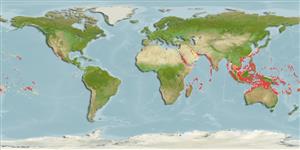
seewasser riff-verbunden; tiefenbereich 3 - 110 m (Ref. 48635), usually 3 - 45 m (Ref. 27115). Tropical; 32°N - 24°S
Indo-Pacific: Red Sea and East Africa to Tonga and the Line Islands.
Größe / Gewicht / Alter
Geschlechtsreife: Lm ? range ? - ? cm
Max length : 20.0 cm TL Männchen/unbestimmt; (Ref. 48635); max. veröff. Alter: 9 Jahre
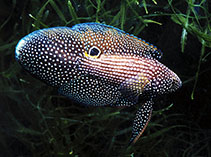
Rückenflossenstacheln (insgesamt) : 11; Rückenflossenweichstrahlen (insgesamt) : 8 - 10; Afterflossenstacheln: 3; Afterflossenweichstrahlen: 9. Characterized by having tubed lateral-line scales 19-20+9-10; depth of body 2.5-2.7 in SL; dorsal and anal fins elevated posteriorly; rounded caudal fin. The false eye which is actually the dorsal fin ocellus confuses predators because it poses an inverted image of a fish. When alarmed, this fish will poke its head into a hole and expose its tail end which mimics the head of the moray eel (Ref. 9710). Head and body brownish black with small pale blue spots; vertical and pelvic fins dark orange-brown, with many small blue spots; blue ringed black ocellus above base of last 3 dorsal rays; yellow spots at base of upper caudal rays; pectoral rays bright yellow, fin membrane transparent (Ref. 10430).
Body shape (shape guide): short and / or deep; Cross section: compressed.
Adults are found near reefs, and in caves and crevices along drop-offs (Ref. 8631). A nocturnal species that hides under ledges and in holes by day (Ref. 9710). They possess a false eye which is actually the dorsal fin ocellus confuses predators because it poses an inverted image of a fish. When alarmed, this fish will poke it's head into a hole and expose its tail end which mimics the head of the moray eel (Ref. 9710). Eggs are guarded by the male parent (Ref. 205). Have been reared in captivity (Ref. 35426). Reported to be living in a marine aquarium for 8 years and 6 months (Danilo Ronchi, Italy, pers.comm. 2014 February). Maximum depth reported taken from Ref. 128797.
Lebenszyklus und Paarungsverhalten
Geschlechtsreife | Fortpflanzung | Ablaichen | Eier | Fruchtbarkeit | Larven
Eggs are guarded by the male parent (Ref. 205).
Randall, J.E., G.R. Allen and R.C. Steene, 1990. Fishes of the Great Barrier Reef and Coral Sea. University of Hawaii Press, Honolulu, Hawaii. 506 p. (Ref. 2334)
IUCN Rote Liste Status (Ref. 130435: Version 2025-2 (Global))
Bedrohung für Menschen
Harmless
Nutzung durch Menschen
Fischereien: kommerziell; Aquarium: Öffentliche Aquarien
Tools
Zusatzinformationen
Download XML
Internet Quellen
Schätzungen auf der Grundlage von Modellen
Bevorzugte Temperatur (Ref.
123201): 24.9 - 29, mean 27.8 °C (based on 1286 cells).
Phylogenetischer Diversitätsindex (Ref.
82804): PD
50 = 0.7500 [Uniqueness, from 0.5 = low to 2.0 = high].
Bayesian length-weight: a=0.01995 (0.00906 - 0.04395), b=3.01 (2.83 - 3.19), in cm total length, based on all LWR estimates for this body shape (Ref.
93245).
Trophische Ebene (Ref.
69278): 4.0 ±0.65 se; based on food items.
Widerstandsfähigkeit (Ref.
120179): mittel, Verdopplung der Population dauert 1,4 - 4,4 Jahre. (Fec = 1,000).
Anfälligkeit der Fischerei (Ref.
59153): Low vulnerability (10 of 100).
🛈
Nährstoffe (Ref.
124155): Calcium = 63.7 [32.2, 112.1] mg/100g; Iron = 0.583 [0.338, 0.939] mg/100g; Protein = 18.8 [17.6, 19.9] %; Omega3 = 0.128 [0.077, 0.205] g/100g; Selenium = 26.9 [15.3, 51.6] μg/100g; VitaminA = 88.8 [27.1, 292.6] μg/100g; Zinc = 1.1 [0.7, 1.6] mg/100g (wet weight);