>
Blenniiformes (Blennies) >
Blenniidae (Combtooth blennies) > Salariinae
Etymology: Ecsenius: Greek, exenios, -os, -on = uncontrolled, immoderate.
Eponymy: In Greek mythology, Midas was a king of Phrygia whose touch could turn anything to gold (a gift from the gods which had to be renounced once the impracticalities sunk in). The fish are named after him because of their golden coloration. (Ref. 128868), visit book page.
Entorno: milieu / zona climática / rango de profundidad / gama de distribución
Ecología
marino asociado a arrecife; rango de profundidad 2 - 40 m (Ref. 30874). Tropical
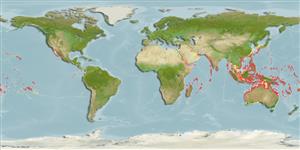
Indo-Pacific: Gulf of Aqaba and southeast coast of Africa to the Marquesan Islands.
Tamaño / Peso / Edad
Madurez: Lm ? range ? - ? cm
Max length : 13.0 cm TL macho / no sexado; (Ref. 2334)
Descripción breve
Claves de identificación | Morfología | Morfometría
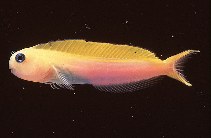
Espinas dorsales (total) : 13 - 14; Radios blandos dorsales (total) : 19 - 21; Espinas anales: 2; Radios blandos anales: 20 - 23. Golden orange in color; black spot around anus; anterior part of dorsal fin with narrow dark margin (Ref. 4404). Indonesian form grey or greenish to golden-yellow. Tail long in adults (Ref. 48636).
Body shape (shape guide): elongated.
Adults inhabit coral reefs (Ref. 9710), from clear coastal to outer reef walls, usually where currents are moderate (Ref. 48636). They swim 2 to 3 m above the benthos, feeding on plankton (Ref. 94105). During the orange-yellow phase, they are observed to school with Pseudanthias squamipinnis which they resemble in color. Individuals of Ecsenius midas can change color quickly from when on the bottom to swimming in open water to match the colors of the fishes they mix with (Ref. 48636). They also socially mimic their swimming behavior and also of Pseudanthias huchtii and Lepidozygus tapeinosomoa (Ref. 90102). Reported to feed on zooplankton (Ref. 37816). Oviparous. Eggs are demersal and adhesive (Ref. 205), and are attached to the substrate via a filamentous, adhesive pad or pedestal (Ref. 94114). Larvae are planktonic, often found in shallow, coastal waters (Ref. 94114). Minimum depth reported taken from Ref. 9710.
Ciclo vital y comportamiento de apareamiento
Madurez | Reproducción | Puesta | Huevos | Fecundidad | Larva
Oviparous, distinct pairing (Ref. 205).
Springer, V.G., 1988. The Indo-Pacific blenniid fish genus Ecsenius. Smithson. Contrib. Zool. (465):134 p. (Ref. 5296)
Situación en la Lista Roja de la UICN (Ref. 130435: Version 2025-2 (Global))
Amenaza para el ser humano
Harmless
Usos humanos
Pesquerías: comercial; Acuario: Comercial
Herramientas
Informes especiales
Descargar XML
Fuentes de Internet
Estimaciones basadas en modelos
Temperatura preferida (Referencia
123201): 24.6 - 29, mean 27.7 °C (based on 716 cells).
Índice de diversidad filogenética (Referencia
82804): PD
50 = 0.5000 [Uniqueness, from 0.5 = low to 2.0 = high].
Bayesian length-weight: a=0.00776 (0.00354 - 0.01702), b=3.00 (2.81 - 3.19), in cm total length, based on LWR estimates for this (Sub)family-body shape (Ref.
93245).
Nivel trófico (Referencia
69278): 2.6 ±0.29 se; based on food items.
Resiliencia (Referencia
120179): Alto, población duplicada en un tiempo mínimo inferior a 15 meses (Preliminary K or Fecundity.).
Vulnerabilidad pesquera (Ref.
59153): Low vulnerability (10 of 100).
🛈
Nutrientes (Ref.
124155): Calcium = 121 [60, 183] mg/100g; Iron = 0.735 [0.441, 1.221] mg/100g; Protein = 18.1 [17.0, 19.1] %; Omega3 = 0.0937 [, ] g/100g; Selenium = 28.6 [14.4, 58.5] μg/100g; VitaminA = 112 [34, 379] μg/100g; Zinc = 2.03 [1.38, 2.82] mg/100g (wet weight);