>
Blenniiformes (Blennies) >
Blenniidae (Combtooth blennies) > Salariinae
Etymology: Ecsenius: Greek, exenios, -os, -on = uncontrolled, immoderate.
Eponymy: In Greek mythology, Midas was a king of Phrygia whose touch could turn anything to gold (a gift from the gods which had to be renounced once the impracticalities sunk in). The fish are named after him because of their golden coloration. (Ref. 128868), visit book page.
Environnement : milieu / zone climatique / profondeur / gamme de distribution
Écologie
marin récifal; profondeur 2 - 40 m (Ref. 30874). Tropical
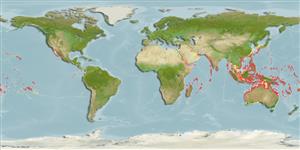
Indo-Pacific: Gulf of Aqaba and southeast coast of Africa to the Marquesan Islands.
Taille / Poids / Âge
Maturité: Lm ? range ? - ? cm
Max length : 13.0 cm TL mâle / non sexé; (Ref. 2334)
Description synthétique
Clés d'identification | Morphologie | Morphométrie
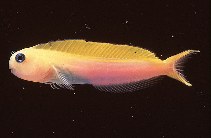
Épines dorsales (Total) : 13 - 14; Rayons mous dorsaux (Total) : 19 - 21; Épines anales: 2; Rayons mous anaux: 20 - 23. Golden orange in color; black spot around anus; anterior part of dorsal fin with narrow dark margin (Ref. 4404). Indonesian form grey or greenish to golden-yellow. Tail long in adults (Ref. 48636).
Body shape (shape guide): elongated.
Adults inhabit coral reefs (Ref. 9710), from clear coastal to outer reef walls, usually where currents are moderate (Ref. 48636). They swim 2 to 3 m above the benthos, feeding on plankton (Ref. 94105). During the orange-yellow phase, they are observed to school with Pseudanthias squamipinnis which they resemble in color. Individuals of Ecsenius midas can change color quickly from when on the bottom to swimming in open water to match the colors of the fishes they mix with (Ref. 48636). They also socially mimic their swimming behavior and also of Pseudanthias huchtii and Lepidozygus tapeinosomoa (Ref. 90102). Reported to feed on zooplankton (Ref. 37816). Oviparous. Eggs are demersal and adhesive (Ref. 205), and are attached to the substrate via a filamentous, adhesive pad or pedestal (Ref. 94114). Larvae are planktonic, often found in shallow, coastal waters (Ref. 94114). Minimum depth reported taken from Ref. 9710.
Cycle de vie et comportement reproducteur
Maturité | Reproduction | Frai | Œufs | Fécondité | Larves
Oviparous, distinct pairing (Ref. 205).
Springer, V.G., 1988. The Indo-Pacific blenniid fish genus Ecsenius. Smithson. Contrib. Zool. (465):134 p. (Ref. 5296)
Statut dans la liste rouge de l'IUCN (Ref. 130435: Version 2025-2 (Global))
Menace pour l'homme
Harmless
Utilisations par l'homme
Pêcheries: commercial; Aquarium: Commercial
Outils
Articles particuliers
Télécharger en XML
Sources Internet
Estimations basées sur des modèles
Température préférée (Réf.
123201): 24.6 - 29, mean 27.7 °C (based on 716 cells).
Indice de diversité phylogénétique (Réf.
82804): PD
50 = 0.5000 [Uniqueness, from 0.5 = low to 2.0 = high].
Bayesian length-weight: a=0.00776 (0.00354 - 0.01702), b=3.00 (2.81 - 3.19), in cm total length, based on LWR estimates for this (Sub)family-body shape (Ref.
93245).
Niveau trophique (Réf.
69278): 2.6 ±0.29 se; based on food items.
Résilience (Réf.
120179): Haut, temps minimum de doublement de population inférieur à 15 mois (Preliminary K or Fecundity.).
Vulnérabilité de la pêche (Ref.
59153): Low vulnerability (10 of 100).
🛈
Nutriments (Ref.
124155): Calcium = 121 [60, 183] mg/100g; Iron = 0.735 [0.441, 1.221] mg/100g; Protein = 18.1 [17.0, 19.1] %; Omega3 = 0.0937 [, ] g/100g; Selenium = 28.6 [14.4, 58.5] μg/100g; VitaminA = 112 [34, 379] μg/100g; Zinc = 2.03 [1.38, 2.82] mg/100g (wet weight);