Classificazione / Nomi
Nomi Comuni | Sinonimi | Catalog of Fishes(Genere, Specie) | ITIS | CoL | WoRMS | Cloffa
>
Cyprinodontiformes (Rivulines, killifishes and live bearers) >
Aphaniidae (Oriental killifishes)
Etymology: Esmaeilius: Named for Hamid Reza Esmaeili (Shiraz) for his extensive contribution to the understanding of diversity within this genus.
Eponymy: Dr Hamid Reza Esmaeili is an Iranian biologist and ichthyologist at Shiraz University, Shiraz where he is full Professor of Ichthyology. [...] (Ref. 128868), visit book page.
Ambiente: milieu / zona climatica / distribuzione batimetrica / gamma di distribuzione
Ecologia
; salmastro benthopelagico. Subtropical; 30°N - 29°N, 52°E - 53°E
Western Indian Ocean: endemic to the Gulf Coast of Iran. (Ref. 31728). Aphanius farsicus has been recorded and collected only from the Maharlu Lake Basin, near Shiraz, Fars province, where it inhabits small freshwater spring-stream systems and pools of varying salinity. Due to the recent droughts in southern Iran, the species is in strong need of conservation (Ref. 88150).
Dimensione / Peso / Età
Maturità: Lm ? range ? - ? cm
Max length : 4.9 cm TL maschio/sesso non determinato; (Ref. 59087)
Breve descrizione
Chiavi di identificazione | Morfologia | Morfometria
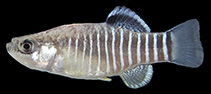
Raggi dorsali molli (totale) : 10 - 14; Raggi anali molli: 10 - 12. A comparison of the meristic characters reveals that the values obtained from the fossil Aphanius persicus (Priem, 1908) are similar to those obtained from the extant A. persicus (Jenkins, 1910), but that the mean numbers of dorsal-fin rays and pectoral fin rays are lower in the fossil. In addition, differences are recognizable with regard to the scales (size and morphology) and teeth (sizes of lateral cusps). The scales are considerably smaller in the fossil than in the extant species. In addition, the morphology of the scales differs as the radii of the fossil scales are separated from each other in the anterior part of the scale, whereas the radii in the scales of the extant species lack this separation. Moreover, the fossil scales have a lower number of circuli and radii in the anterior field than the scales of the recent species. the comparison of the tricuspid jaw teeth at the premaxillary and dentary reveals that the central cusp is of similar length in the fossil and the extant species, but that the lateral cusps are slightly longer (0.05 mm) in the fossil in comparison with the recent species (0.02–0.03 mm) (Ref. 88150).
Body shape (shape guide): fusiform / normal.
Ciclo vitale e comportamento di accoppiamento
Maturità | Riproduzione | Deposizione | Uova | Fecondità | Larve
Freyhof, J. and B. Yoğurtçuoğlu, 2020. A proposal for a new generic structure of the killifish family Aphaniidae, with the description of Aphaniops teimorii (Teleostei: Cyprinodontiformes). Zootaxa 4810(3):421-451. (Ref. 126233)
Stato della Lista Rossa IUCN (Ref. 130435: Version 2025-2 (Global))
Minaccia per l'uomo
Harmless
Usi umani
Strumenti
Rapporti speciali
Scarica XML
Fonti Internet
Stime basate su modelli
Indice di diversità filogenetica (Fonte Biblio.
82804): PD
50 = 0.5156 [Uniqueness, from 0.5 = low to 2.0 = high].
Bayesian length-weight: a=0.01000 (0.00631 - 0.01585), b=3.30 (3.17 - 3.43), in cm total length, based on LWR estimates for this species & Genus-body shape (Ref.
93245).
Livello trofico (Fonte Biblio.
69278): 2.9 ±0.4 se; based on size and trophs of closest relatives
Resilienza (Fonte Biblio.
120179): Alto, tempo minimo di raddoppiamento della popolazione meno di 15 mesi (Preliminary K or Fecundity.).
Vulnerabilità della pesca (Ref.
59153): Low vulnerability (10 of 100).
🛈