>
Cyprinodontiformes (Rivulines, killifishes and live bearers) >
Aphaniidae (Oriental killifishes)
Etymology: Esmaeilius: Named for Hamid Reza Esmaeili (Shiraz) for his extensive contribution to the understanding of diversity within this genus.
Eponymy: Dr Hamid Reza Esmaeili is an Iranian biologist and ichthyologist at Shiraz University, Shiraz where he is full Professor of Ichthyology. [...] (Ref. 128868), visit book page.
Milieu: milieu / Klimaatzone / Diepte / verspreidingsgebied
Ecologie
; brak water benthopelagisch. Subtropical; 30°N - 29°N, 52°E - 53°E
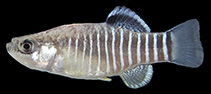
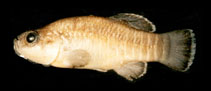
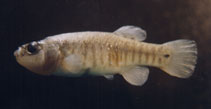
Western Indian Ocean: endemic to the Gulf Coast of Iran. (Ref. 31728). Aphanius farsicus has been recorded and collected only from the Maharlu Lake Basin, near Shiraz, Fars province, where it inhabits small freshwater spring-stream systems and pools of varying salinity. Due to the recent droughts in southern Iran, the species is in strong need of conservation (Ref. 88150).
Grootte / Gewicht / Leeftijd
Maturiteit: Lm ? range ? - ? cm
Max length : 4.9 cm TL mannelijk / geslacht onbekend; (Ref. 59087)
Korte beschrijving
Determinatiesleutels | Morfologie | Morfometrie
Dorsale zachte stralen (totaal) : 10 - 14; Anale zachte stralen: 10 - 12. A comparison of the meristic characters reveals that the values obtained from the fossil Aphanius persicus (Priem, 1908) are similar to those obtained from the extant A. persicus (Jenkins, 1910), but that the mean numbers of dorsal-fin rays and pectoral fin rays are lower in the fossil. In addition, differences are recognizable with regard to the scales (size and morphology) and teeth (sizes of lateral cusps). The scales are considerably smaller in the fossil than in the extant species. In addition, the morphology of the scales differs as the radii of the fossil scales are separated from each other in the anterior part of the scale, whereas the radii in the scales of the extant species lack this separation. Moreover, the fossil scales have a lower number of circuli and radii in the anterior field than the scales of the recent species. the comparison of the tricuspid jaw teeth at the premaxillary and dentary reveals that the central cusp is of similar length in the fossil and the extant species, but that the lateral cusps are slightly longer (0.05 mm) in the fossil in comparison with the recent species (0.02–0.03 mm) (Ref. 88150).
Body shape (shape guide): fusiform / normal.
Levenscyclus en paargedrag
Maturiteit | Voortplanting | Paaien | Eieren | Fecunditeit | Larven
Freyhof, J. and B. Yoğurtçuoğlu, 2020. A proposal for a new generic structure of the killifish family Aphaniidae, with the description of Aphaniops teimorii (Teleostei: Cyprinodontiformes). Zootaxa 4810(3):421-451. (Ref. 126233)
Status op de Rode Lijst van het IUCN (Ref. 130435: Version 2025-2 (Global))
Gevaar voor de mens
Harmless
Gebruik door de mens
Tools
Speciale rapporten
Download XML
Internetbronnen
Schattingen op basis van modellen
Fylogenetische diversiteitsindex (Ref.
82804): PD
50 = 0.5156 [Uniqueness, from 0.5 = low to 2.0 = high].
Bayesian length-weight: a=0.01000 (0.00631 - 0.01585), b=3.30 (3.17 - 3.43), in cm total length, based on LWR estimates for this species & Genus-body shape (Ref.
93245).
Trofisch niveau (Ref.
69278): 2.9 ±0.4 se; based on size and trophs of closest relatives
Weerstandsvermogen (Ref.
120179): Hoog, minimale populatieverdubbelingstijd minder dan 15 maanden (Preliminary K or Fecundity.).
Kwetsbaarheid van de visserij (Ref.
59153): Low vulnerability (10 of 100).
🛈