>
Eupercaria/misc (Various families in series Eupercaria) >
Gerreidae (Mojarras)
Etymology: Gerres: Latin, gerres = a kind of anchovies; cited by Plinius.
More on author: Cuvier.
Ambiente: milieu / zona climatica / distribuzione batimetrica / gamma di distribuzione
Ecologia
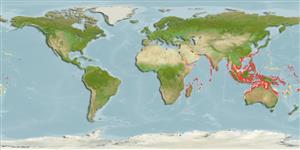
marino associati a barriera corallina; distribuzione batimetrica 0 - 50 m (Ref. 86942). Tropical; 30°N - 36°S, 19°E - 165°W
Indo-Pacific: Red Sea and East Africa to Samoa and Tonga, north to the Ryukyu Islands, south to New Caledonia.
Dimensione / Peso / Età
Maturità: Lm ? range ? - ? cm
Max length : 30.0 cm SL maschio/sesso non determinato; (Ref. 1602); common length : 15.0 cm TL maschio/sesso non determinato; (Ref. 2871)
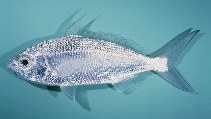
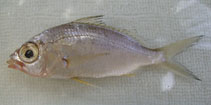
Spine dorsali (totale) : 9; Raggi dorsali molli (totale) : 10; Spine anali: 3; Raggi anali molli: 7. Scales between 5th dorsal fin spine base and lateral line, 4-4.5. Upper jaw extending almost to the level of anterior margin of dermal eye opening. Second dorsal fin spine longest, 19-26% of SL (mean 23%). Caudal fin dusky (rarely with dark distal margin); lower edge of lower caudal fin hyaline. Dusky stripes absent or very indistinct along scale rows above lateral line (sometimes 4-9 slightly oblique dusky bands in specimens less than about 10 cm SL); 4-9 slightly oblique dusky bands or columns of ovoid dark spots (rarely brownish) immediately below lateral line, but more obvious in preserved or stressed live specimens (Ref. 41108). Adult body plain silver; may have faint dusky bars especially juveniles. Body elongate, depth max 2.8-3.3 in SL. Preopercle lower flange scaleless. Caudal fin forked deeply and with long lobes; pectoral fins do not reach beyond level of anus. (Ref. 90102)
Body shape (shape guide): fusiform / normal; Cross section: compressed.
Prefers coralline areas (Ref. 30573). Migrates to specific sandy areas near outer reef edge to spawn in late afternoons during full moon. Feeds on small benthic organisms living on sandy bottoms (Ref. 3409, 48635). In Palau, migrates to specific sandy spots near the outer reef edge to spawn in late afternoons around full moon (Ref. 37816). Forms schools. Feeds on small invertebrates found in the sand. Marketed fresh (Ref. 12915).
Ciclo vitale e comportamento di accoppiamento
Maturità | Riproduzione | Deposizione | Uova | Fecondità | Larve
Myers, R.F., 1991. Micronesian reef fishes. Second Ed. Coral Graphics, Barrigada, Guam. 298 p. (Ref. 1602)
Stato della Lista Rossa IUCN (Ref. 130435: Version 2025-2 (Global))
Minaccia per l'uomo
Harmless
Usi umani
Pesca: commerciale
Strumenti
Rapporti speciali
Scarica XML
Fonti Internet
Stime basate su modelli
Temperatura preferita (Fonte Biblio.
123201): 24.9 - 29.3, mean 28.5 °C (based on 3192 cells).
Indice di diversità filogenetica (Fonte Biblio.
82804): PD
50 = 0.5000 [Uniqueness, from 0.5 = low to 2.0 = high].
Bayesian length-weight: a=0.01000 (0.00574 - 0.01742), b=3.00 (2.86 - 3.14), in cm total length, based on LWR estimates for this species & Genus-body shape (Ref.
93245).
Livello trofico (Fonte Biblio.
69278): 3.5 ±0.37 se; based on food items.
Resilienza (Fonte Biblio.
120179): Medio, tempo minimo di raddoppiamento della popolazione 1.4 - 4.4 anni (Preliminary K or Fecundity.).
Vulnerabilità della pesca (Ref.
59153): Low to moderate vulnerability (27 of 100).
🛈
Vulnerabilità climatica (Ref.
125649): High to very high vulnerability (70 of 100).
🛈
Nutrienti (Ref.
124155): Calcium = 58.2 [28.7, 93.5] mg/100g; Iron = 0.585 [0.283, 0.984] mg/100g; Protein = 19.3 [17.4, 21.1] %; Omega3 = 0.148 [0.085, 0.241] g/100g; Selenium = 30.7 [18.2, 52.9] μg/100g; VitaminA = 80.7 [22.0, 224.5] μg/100g; Zinc = 1.23 [0.85, 1.73] mg/100g (wet weight);