>
Eupercaria/misc (Various families in series Eupercaria) >
Gerreidae (Mojarras)
Etymology: Gerres: Latin, gerres = a kind of anchovies; cited by Plinius.
More on author: Cuvier.
Môi trường: môi trường / vùng khí hậu / Mức độ sâu / phạm vi phân phối
Sinh thái học
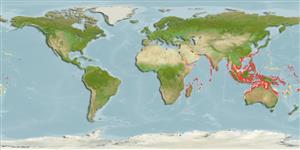
biển cùng sống ở rạn san hô; mức độ sâu 0 - 50 m (Ref. 86942). Tropical; 30°N - 36°S, 19°E - 165°W
Indo-Pacific: Red Sea and East Africa to Samoa and Tonga, north to the Ryukyu Islands, south to New Caledonia.
Bộ gần gũi / Khối lượng (Trọng lượng) / Tuổi
Chín muồi sinh dục: Lm ? range ? - ? cm
Max length : 30.0 cm SL con đực/không giới tính; (Ref. 1602); common length : 15.0 cm TL con đực/không giới tính; (Ref. 2871)
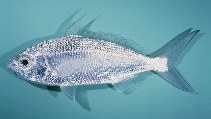
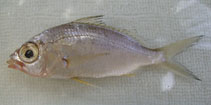
Các tia vây lưng cứng (tổng cộng) : 9; Các vây lưng mềm (tổng cộng) : 10; Tia cứng vây hậu môn: 3; Tia mềm vây hậu môn: 7. Scales between 5th dorsal fin spine base and lateral line, 4-4.5. Upper jaw extending almost to the level of anterior margin of dermal eye opening. Second dorsal fin spine longest, 19-26% of SL (mean 23%). Caudal fin dusky (rarely with dark distal margin); lower edge of lower caudal fin hyaline. Dusky stripes absent or very indistinct along scale rows above lateral line (sometimes 4-9 slightly oblique dusky bands in specimens less than about 10 cm SL); 4-9 slightly oblique dusky bands or columns of ovoid dark spots (rarely brownish) immediately below lateral line, but more obvious in preserved or stressed live specimens (Ref. 41108). Adult body plain silver; may have faint dusky bars especially juveniles. Body elongate, depth max 2.8-3.3 in SL. Preopercle lower flange scaleless. Caudal fin forked deeply and with long lobes; pectoral fins do not reach beyond level of anus. (Ref. 90102)
Body shape (shape guide): fusiform / normal; Cross section: compressed.
Prefers coralline areas (Ref. 30573). Migrates to specific sandy areas near outer reef edge to spawn in late afternoons during full moon. Feeds on small benthic organisms living on sandy bottoms (Ref. 3409, 48635). In Palau, migrates to specific sandy spots near the outer reef edge to spawn in late afternoons around full moon (Ref. 37816). Forms schools. Feeds on small invertebrates found in the sand. Marketed fresh (Ref. 12915).
Vòng đời và hành vi giao phối
Chín muồi sinh dục | Sự tái sinh sản | Đẻ trứng | Các trứng | Sự sinh sản | Ấu trùng
Myers, R.F., 1991. Micronesian reef fishes. Second Ed. Coral Graphics, Barrigada, Guam. 298 p. (Ref. 1602)
Tình trạng Sách đỏ IUCN (Ref. 130435: Version 2025-2 (Global))
Mối đe dọa đối với con người
Harmless
Sử dụng của con người
Các nghề cá: tính thương mại
Các công cụ
Báo cáo đặc biệt
Tải xuống XML
Các nguồn internet
Ước tính dựa trên mô hình
Nhiệt độ ưa thích (Tài liệu tham khảo
123201): 24.9 - 29.3, mean 28.5 °C (based on 3192 cells).
Chỉ số đa dạng phát sinh loài (Tài liệu tham khảo
82804): PD
50 = 0.5000 [Uniqueness, from 0.5 = low to 2.0 = high].
Bayesian length-weight: a=0.01000 (0.00574 - 0.01742), b=3.00 (2.86 - 3.14), in cm total length, based on LWR estimates for this species & Genus-body shape (Ref.
93245).
Mức dinh dưỡng (Tài liệu tham khảo
69278): 3.5 ±0.37 se; based on food items.
Thích nghi nhanh (Tài liệu tham khảo
120179): Trung bình, thời gian nhân đôi của chủng quần tối thiểu là 1.4 - 4.4 năm (Preliminary K or Fecundity.).
Sự dễ bị tổn thương của nghề đánh cá (Ref.
59153): Low to moderate vulnerability (27 of 100).
🛈
Sự dễ bị tổn thương của khí hậu (Ref.
125649): High to very high vulnerability (70 of 100).
🛈
Chất dinh dưỡng (Ref.
124155): Calcium = 58.2 [28.7, 93.5] mg/100g; Iron = 0.585 [0.283, 0.984] mg/100g; Protein = 19.3 [17.4, 21.1] %; Omega3 = 0.148 [0.085, 0.241] g/100g; Selenium = 30.7 [18.2, 52.9] μg/100g; VitaminA = 80.7 [22.0, 224.5] μg/100g; Zinc = 1.23 [0.85, 1.73] mg/100g (wet weight);