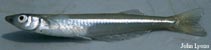
Klassifizierung / Names
Namen | Synonyme | Catalog of Fishes(Gattung, Arten) | ITIS | CoL | WoRMS | Cloffa
>
Atheriniformes (Silversides) >
Atherinopsidae (Neotropical silversides) > Menidiinae
Etymology: Labidesthes: Greek, labidos = pair of forceps + Greek esthio = to eat; in reference to the shape of the mouth (Ref. 45335); sicculus: Name most likely from Latin 'sicula' meaning small dagger (see Ref. 104856). Others consider the origin of the name from the Latin 'siccus' meaning dried, referring to being found in dried pools (Ref. 10294, 79012).
More on author: Cope.
Umwelt: Milieu / Klimazone / Tiefenbereich / Verbreitungsgebiet
Ökologie
; süßwasser pelagisch; standorttreu (Ref. 126106). Subtropical; 5°C - 20°C (Ref. 13614); 46°N - 25°N
North America: Gulf of Mexico drainages from the Pearl River west to Brazos River including sthe Mississippi River drainage, and the Great Lakes (but not Lake Superior) - St. Lawrence River drainages.
Länge bei der ersten Reifung / Größe / Gewicht / Alter
Geschlechtsreife: Lm 7.0 range ? - ? cm
Max length : 13.0 cm TL Männchen/unbestimmt; (Ref. 5723); common length : 8.4 cm TL Männchen/unbestimmt; (Ref. 12193); max. veröff. Alter: 2.00 Jahre (Ref. 12193)
Rückenflossenstacheln (insgesamt) : 4 - 7; Rückenflossenweichstrahlen (insgesamt) : 8 - 12; Afterflossenstacheln: 1; Afterflossenweichstrahlen: 19 - 27. This species is distinguished and differs from Labidesthes vanhyningi by the following characters: Labidesthes sicculus have the anterolateral processes of the posttemporals longer than width of the base (vs. L. vanhyningi having the processes shorter than width of base); with a midlateral stripe tapering to insertion of pectoral fin in advance of first dorsal fin (vs. maintaining width or usually expanding, to insertion of pectoral fin in advance of the first dorsal-fin); a ratio of thoracic length to abdominal length greater than 2 (vs. less than 2) (Ref. 104856).
Body shape (shape guide): elongated; Cross section: compressed.
Adults occur near surface of lakes, ponds, and quiet pools of creeks and small to large rivers. Usually found in open water (Ref 5723, 10294). They feed on zooplankton, including copepods, cladocerans, and midge larvae (Ref. 10294).
Lebenszyklus und Paarungsverhalten
Geschlechtsreife | Fortpflanzung | Ablaichen | Eier | Fruchtbarkeit | Larven
Werneke, D.C. and J.W. Armbruster, 2015. Silversides of the genus Labidesthes (Atheriniformes: Atherinopsidae). Zootaxa 4032(5):535-550. (Ref. 104856)
IUCN Rote Liste Status (Ref. 130435: Version 2025-2 (Global))
Bedrohung für Menschen
Harmless
Nutzung durch Menschen
Köder: usually
Tools
Zusatzinformationen
Download XML
Internet Quellen
Schätzungen auf der Grundlage von Modellen
Phylogenetischer Diversitätsindex (Ref.
82804): PD
50 = 0.7500 [Uniqueness, from 0.5 = low to 2.0 = high].
Bayesian length-weight: a=0.00447 (0.00241 - 0.00829), b=3.03 (2.86 - 3.20), in cm total length, based on LWR estimates for this species & (Sub)family-body (Ref.
93245).
Trophische Ebene (Ref.
69278): 3.4 ±0.45 se; based on food items.
Widerstandsfähigkeit (Ref.
120179): hoch, Verdopplung der Population dauert weniger als 15 Monate. (K=3.70; tmax=2).
Anfälligkeit der Fischerei (Ref.
59153): Low vulnerability (10 of 100).
🛈