>
Osmeriformes (Freshwater smelts) >
Osmeridae (Smelts)
Etymology: Mallotus: Greek for fleecy, derived from mallos = wool, and -otus = a Greek adjectival suffix referring to property; referring to the shape of the scales along the side of breeding males, appearing hairy or fleecy (S.Kullander, pers. Comm.).
Περιβάλλον: περιβάλλον / κλιματική ζώνη / εύρος βάθους / εύρος διανομής
Οικολογία
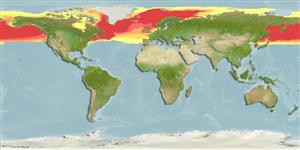
Θαλασσινό(ά); Γλυκού νερού; Υφάλμυρο pelagic-oceanic; ανάδρομο (Ref. 46888); εύρος βάθους 0 - 725 m (Ref. 58426), usually ? - 200 m (Ref. 96339). Polar; 84°N - 37°N, 180°W - 180°E (Ref. 54574)
Circumpolar in the Arctic. North Atlantic: Barents Sea up to Bear Island, in the White and Norwegian seas, off the coast of Greenland up to 76°30'N and from Hudson Bay in Canada to Gulf of Maine, USA. North Pacific: south to Korea and Juan de Fuca Strait, Canada.
Μήκος κατά την πρώτη ωρίμανση / Μέγεθος / Βάρος / Ηλικία
Γεννητική Ωρίμανση: Lm 13.3, range 15 - 19 cm
Max length : 20.0 cm TL αρσενικό/απροσδιόριστο; (Ref. 11626); 25.2 cm TL (female); common length : 15.0 cm TL αρσενικό/απροσδιόριστο; (Ref. 4645); μεγ. δημοσιευμένο βάρος: 52.00 g (Ref. 56475); μεγ. αναφερόμενη ηλικία: 10 έτη (Ref. 72498)
Σύντομη περιγραφή
Κλείδες προσδιορισμού | Μορφολογία | Μορφομετρία
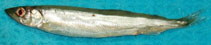
Ραχιαίες άκανθες (συνολικά) : 0; Μαλακές ραχιαίες ακτίνες (συνολικά) : 10 - 14; Εδρικές άκανθες: 0; Μαλακές εδρικές ακτίνες: 16 - 23; Σπόνδυλοι: 62 - 73. Adipose with long base, about 1.5 times as long as the orbit or longer, outer margin only slightly curved (Ref. 6885). Olive green on dorsal surface, merging into silvery on sides and ventral surface (Ref. 6885).
Body shape (shape guide): elongated.
Oceanic species found in schools (Ref. 2850). Nerito-pelagic (Ref. 58426); however, reported at 1086 m Davis Strait to southern Baffin Bay (Ref. 120413). Adults feed on planktonic crustaceans, copepods, euphausiids, amphipods, marine worms, and small fishes (Ref. 6885, 35388). Mature individuals move inshore in large schools to spawn (Ref. 2850). In the spring large spawning shoals migrate toward the coasts, males usually arrive first. Often entering brackish and freshwater (Ref. 37812). Semelparous (Ref. 51846). Produces 6,000-12,000 adhesive eggs. Females are valued for their roe, males are utilized as fishmeal. Marketed canned and frozen; eaten fried and dried (Ref. 9988). Possibly to 725 m depth (Ref. 6793).
Reproductive strategy: synchronous ovarian organization, determinate fecundity (Ref. 51846). Experimental testing suggests facultative semelparity, with offshore-spawning capelin being absolute semelparous (death of both genders) and beach-spawning capelin being iteroparous irrespective of sex (Ref. 92136). Also Ref. 92150.
Eschmeyer, W.N., E.S. Herald and H. Hammann, 1983. A field guide to Pacific coast fishes of North America. Boston (MA, USA): Houghton Mifflin Company. xii+336 p. (Ref. 2850)
Κατάσταση Κόκκινου Καταλόγου IUCN (Ref. 130435: Version 2025-2 (Global))
Απειλή για τον άνθρωπο
Harmless
Ανθρώπινες χρήσεις
αλιεία: πολύ εμπορικό
Εργαλεία
Ειδικές εκθέσεις
Λήψη XML
Διαδικτυακές πηγές
Εκτιμήσεις βάσει μοντέλων
Προτιμώμενη θερμοκρασία (Αναφ.
123201): 0.3 - 7.1, mean 2.7 °C (based on 956 cells).
Δείκτης φυλογενετικής ποικιλότητας (Αναφ.
82804): PD
50 = 1.0000 [Uniqueness, from 0.5 = low to 2.0 = high].
Bayesian length-weight: a=0.00363 (0.00290 - 0.00455), b=3.21 (3.14 - 3.28), in cm total length, based on LWR estimates for this species (Ref.
93245).
Τροφικό Επίπεδο (Αναφ.
69278): 3.2 ±0.1 se; based on diet studies.
Ελαστικότητα (Αναφ.
120179): Μεσαίο(α), ελάχιστος χρόνος για διπλασιασμό πληθυσμού 1,4 - 4,4 έτη (K=0.3-0.5; tm=3; tmax=10; Fec=6,000).
Prior r = 0.62, 95% CL = 0.41 - 0.94, Based on 5 full stock assessments.
Ευπάθεια στην αλιεία (Ref.
59153): Low to moderate vulnerability (27 of 100).
🛈
Ευπάθεια στο κλίμα (Ref.
125649): Low vulnerability (24 of 100).
🛈
Θρεπτικά συστατικά (Ref.
124155): Calcium = 61.5 [23.6, 173.6] mg/100g; Iron = 0.789 [0.272, 2.351] mg/100g; Protein = 16.4 [15.2, 17.5] %; Omega3 = 0.546 [0.230, 1.330] g/100g; Selenium = 13.4 [4.3, 35.4] μg/100g; VitaminA = 21.6 [4.0, 119.8] μg/100g; Zinc = 0.682 [0.407, 1.150] mg/100g (wet weight); based on
nutrient studies.