>
Osmeriformes (Freshwater smelts) >
Osmeridae (Smelts)
Etymology: Mallotus: Greek for fleecy, derived from mallos = wool, and -otus = a Greek adjectival suffix referring to property; referring to the shape of the scales along the side of breeding males, appearing hairy or fleecy (S.Kullander, pers. Comm.).
Ambiente: milieu / zona climatica / distribuzione batimetrica / gamma di distribuzione
Ecologia
marino; acqua dolce; salmastro pelagic-oceanic; anadromo (Ref. 46888); distribuzione batimetrica 0 - 725 m (Ref. 58426), usually ? - 200 m (Ref. 96339). Polar; 84°N - 37°N, 180°W - 180°E (Ref. 54574)
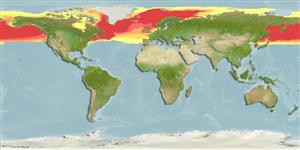
Circumpolar in the Arctic. North Atlantic: Barents Sea up to Bear Island, in the White and Norwegian seas, off the coast of Greenland up to 76°30'N and from Hudson Bay in Canada to Gulf of Maine, USA. North Pacific: south to Korea and Juan de Fuca Strait, Canada.
Lunghezza alla prima maturità / Dimensione / Peso / Età
Maturità: Lm 13.3, range 15 - 19 cm
Max length : 20.0 cm TL maschio/sesso non determinato; (Ref. 11626); 25.2 cm TL (female); common length : 15.0 cm TL maschio/sesso non determinato; (Ref. 4645); peso massimo pubblicato: 52.00 g (Ref. 56475); Età massima riportata: 10 anni (Ref. 72498)
Breve descrizione
Chiavi di identificazione | Morfologia | Morfometria
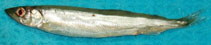
Spine dorsali (totale) : 0; Raggi dorsali molli (totale) : 10 - 14; Spine anali: 0; Raggi anali molli: 16 - 23; Vertebre: 62 - 73. Adipose with long base, about 1.5 times as long as the orbit or longer, outer margin only slightly curved (Ref. 6885). Olive green on dorsal surface, merging into silvery on sides and ventral surface (Ref. 6885).
Body shape (shape guide): elongated.
Oceanic species found in schools (Ref. 2850). Nerito-pelagic (Ref. 58426); however, reported at 1086 m Davis Strait to southern Baffin Bay (Ref. 120413). Adults feed on planktonic crustaceans, copepods, euphausiids, amphipods, marine worms, and small fishes (Ref. 6885, 35388). Mature individuals move inshore in large schools to spawn (Ref. 2850). In the spring large spawning shoals migrate toward the coasts, males usually arrive first. Often entering brackish and freshwater (Ref. 37812). Semelparous (Ref. 51846). Produces 6,000-12,000 adhesive eggs. Females are valued for their roe, males are utilized as fishmeal. Marketed canned and frozen; eaten fried and dried (Ref. 9988). Possibly to 725 m depth (Ref. 6793).
Reproductive strategy: synchronous ovarian organization, determinate fecundity (Ref. 51846). Experimental testing suggests facultative semelparity, with offshore-spawning capelin being absolute semelparous (death of both genders) and beach-spawning capelin being iteroparous irrespective of sex (Ref. 92136). Also Ref. 92150.
Eschmeyer, W.N., E.S. Herald and H. Hammann, 1983. A field guide to Pacific coast fishes of North America. Boston (MA, USA): Houghton Mifflin Company. xii+336 p. (Ref. 2850)
Stato della Lista Rossa IUCN (Ref. 130435: Version 2025-2 (Global))
Minaccia per l'uomo
Harmless
Usi umani
Pesca: elevato interesse commerciale
Strumenti
Rapporti speciali
Scarica XML
Fonti Internet
Stime basate su modelli
Temperatura preferita (Fonte Biblio.
123201): 0.3 - 7.1, mean 2.7 °C (based on 956 cells).
Indice di diversità filogenetica (Fonte Biblio.
82804): PD
50 = 1.0000 [Uniqueness, from 0.5 = low to 2.0 = high].
Bayesian length-weight: a=0.00363 (0.00290 - 0.00455), b=3.21 (3.14 - 3.28), in cm total length, based on LWR estimates for this species (Ref.
93245).
Livello trofico (Fonte Biblio.
69278): 3.2 ±0.1 se; based on diet studies.
Resilienza (Fonte Biblio.
120179): Medio, tempo minimo di raddoppiamento della popolazione 1.4 - 4.4 anni (K=0.3-0.5; tm=3; tmax=10; Fec=6,000).
Prior r = 0.62, 95% CL = 0.41 - 0.94, Based on 5 full stock assessments.
Vulnerabilità della pesca (Ref.
59153): Low to moderate vulnerability (27 of 100).
🛈
Vulnerabilità climatica (Ref.
125649): Low vulnerability (24 of 100).
🛈
Nutrienti (Ref.
124155): Calcium = 61.5 [23.6, 173.6] mg/100g; Iron = 0.789 [0.272, 2.351] mg/100g; Protein = 16.4 [15.2, 17.5] %; Omega3 = 0.546 [0.230, 1.330] g/100g; Selenium = 13.4 [4.3, 35.4] μg/100g; VitaminA = 21.6 [4.0, 119.8] μg/100g; Zinc = 0.682 [0.407, 1.150] mg/100g (wet weight); based on
nutrient studies.