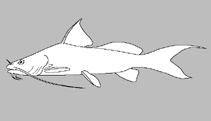
Classificação / Nomes
Nomes comuns | Sinónimos | Catalog of Fishes(Género, Espécies) | ITIS | CoL | WoRMS | Cloffa
>
Siluriformes (Catfishes) >
Bagridae (Bagrid catfishes)
Etymology: Olyra: Greek, olyra = a kind of grain (Ref. 45335); astrifera: The specific name refers to the distribution of star- shaped dots all over the body. A feminine noun in adjective.
Ambiente: milieu / zona climática / intervalo de profundidade / gama de distribuição
Ecologia
; Água doce demersal. Tropical
Asia: Manimalai River in Kerala, India.
Tamanho / Peso / Idade
Maturidade: Lm ? range ? - ? cm
Max length : 3.3 cm SL macho/indeterminado; (Ref. 93959)
Descrição breve
Chaves de identificação | Morfologia | Morfometria
Raios dorsais moles (total) : 7; Raios anais moles: 15. This species is diagnosed from its congeners, except Olyra horae, by having following characters: adipose fin confluent with caudal base; pectoral fins with weak serrations and strong dentitions internally consisitng of 10-12; anal fin with 15 rays; length of the adipose fin base 31.2-33.2% SL; distance of dorsal fin origin to origin of adipose fin 21.6-22.5% SL; and 17-23 pores of the lateral line canal. It differs from O. horae by having 15 anal fin rays (vs. 21) upper lobe of caudal fin extending posteriorly by a length that is more than half the length of the lower lobe (vs. slightly longer than lower). The following combination of characters separate this species from other congeners: pre-dorsal length 41.9-42.3 % SL; pre-anal length 61.8-66.2 % SL; anal fin base length 23.6-25 % SL; length of the lower lobe of the caudal fin 21.4-21.6 % SL; caudal peduncle length 10-10.6 % SL; caudal peduncle depth 11.1-11.4 % SL; head length 23-23.6 % SL; nasal barbel length 42-42.2% HL; head width at eye 50.5-51.3% HL; eye diameter 12.2-12.9% HL; dorsal fin rays i 6; pectoral fin rays i 6; caudal fin rays 27 rays; pelvic fin length 15-15.1 % SL; pectoral fin length 11.3-12.1% SL; body depth 9.1-9.9% SL; and
snout length 32.1-33% SL (Ref. 93959).
Body shape (shape guide): elongated.
Inhabits river with relatively clear water, substratum composed mostly of sand and small boulders, width of 62 m, depth from 0.5-4.5 m and 80-90 % riparian cover mostly overhanging vegetation. Encountered in exposed bamboo roots along the edges of the bank with leaf litter and small grasses (Ref. 93959).
Ciclo de vida e comportamento de acasalamento
Maturidade | Reprodução | Desova | Ovos | Fecundidade | Larvas
Arunachalam, M., M. Raja, R.L. Maydem and A. Chandran, 2013. Olyra astrifera a new species of Olyrid catfish from the Western Ghats, Southern India (Teleostei: Bagridae: Olyrininae) and the designation of neotype, Olyra Longicaudata McClelland, 1842 from the North Eastern India. Intl. J. Zool. Res. 3(2):51-60. (Ref. 93959)
Categoria na Lista Vermelha da IUCN (Ref. 130435: Version 2025-2 (Global))
Ameaça para o homem
Harmless
Utilização humana
Ferramentas
Relatórios especiais
Descarregue XML
Fontes da internet
Estimativas baseadas em modelos
Índice de diversidade filogenética (Ref.
82804): PD
50 = 0.5039 [Uniqueness, from 0.5 = low to 2.0 = high].
Bayesian length-weight: a=0.00871 (0.00415 - 0.01826), b=2.93 (2.76 - 3.10), in cm total length, based on LWR estimates for this (Sub)family-body shape (Ref.
93245).
Nível Trófico (Ref.
69278): 3.1 ±0.1 se; based on size and trophs of closest relatives
Resiliência (Ref.
120179): Elevada, tempo mínimo de duplicação da população menor que 15 meses (Preliminary K or Fecundity.).
Vulnerabilidade da pesca (Ref.
59153): Low vulnerability (10 of 100).
🛈