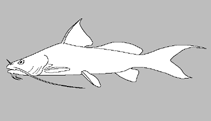
Classificação / Nomes
Nomes comuns | Sinônimos | Catalog of Fishes(Gênero, Espécies) | ITIS | CoL | WoRMS | Cloffa
>
Siluriformes (Catfishes) >
Bagridae (Bagrid catfishes)
Etymology: Olyra: Greek, olyra = a kind of grain (Ref. 45335); astrifera: The specific name refers to the distribution of star- shaped dots all over the body. A feminine noun in adjective.
Meio ambiente: milieu / Zona climática / intervalo de profundidade / faixa de distribuição
Ecologia
; Água doce demersal. Tropical
Asia: Manimalai River in Kerala, India.
Tamanho / Peso / Idade
Maturidade: Lm ? range ? - ? cm
Max length : 3.3 cm SL macho/indeterminado; (Ref. 93959)
Descrição suscinta
Chaves de identificação | Morfologia | Morfometria
Raios dorsais (total) : 7; Raios anais : 15. This species is diagnosed from its congeners, except Olyra horae, by having following characters: adipose fin confluent with caudal base; pectoral fins with weak serrations and strong dentitions internally consisitng of 10-12; anal fin with 15 rays; length of the adipose fin base 31.2-33.2% SL; distance of dorsal fin origin to origin of adipose fin 21.6-22.5% SL; and 17-23 pores of the lateral line canal. It differs from O. horae by having 15 anal fin rays (vs. 21) upper lobe of caudal fin extending posteriorly by a length that is more than half the length of the lower lobe (vs. slightly longer than lower). The following combination of characters separate this species from other congeners: pre-dorsal length 41.9-42.3 % SL; pre-anal length 61.8-66.2 % SL; anal fin base length 23.6-25 % SL; length of the lower lobe of the caudal fin 21.4-21.6 % SL; caudal peduncle length 10-10.6 % SL; caudal peduncle depth 11.1-11.4 % SL; head length 23-23.6 % SL; nasal barbel length 42-42.2% HL; head width at eye 50.5-51.3% HL; eye diameter 12.2-12.9% HL; dorsal fin rays i 6; pectoral fin rays i 6; caudal fin rays 27 rays; pelvic fin length 15-15.1 % SL; pectoral fin length 11.3-12.1% SL; body depth 9.1-9.9% SL; and
snout length 32.1-33% SL (Ref. 93959).
Body shape (shape guide): elongated.
Inhabits river with relatively clear water, substratum composed mostly of sand and small boulders, width of 62 m, depth from 0.5-4.5 m and 80-90 % riparian cover mostly overhanging vegetation. Encountered in exposed bamboo roots along the edges of the bank with leaf litter and small grasses (Ref. 93959).
Ciclo de vida ou comportamento de acasalamento
Maturidade | Reprodução | Desova | Ovos | Fecundidade | Larvas
Arunachalam, M., M. Raja, R.L. Maydem and A. Chandran, 2013. Olyra astrifera a new species of Olyrid catfish from the Western Ghats, Southern India (Teleostei: Bagridae: Olyrininae) and the designation of neotype, Olyra Longicaudata McClelland, 1842 from the North Eastern India. Intl. J. Zool. Res. 3(2):51-60. (Ref. 93959)
Status na Lista Vermelha da UICN (Ref. 130435: Version 2025-2 (Global))
Ameaça para os humanos
Harmless
Uso pelos humanos
Ferramentas
Relatórios especiais
Baixar XML
Fontes da internet
Estimativas baseadas em modelos
Índice de diversidade filogenética (Ref.
82804): PD
50 = 0.5039 [Uniqueness, from 0.5 = low to 2.0 = high].
Bayesian length-weight: a=0.00871 (0.00415 - 0.01826), b=2.93 (2.76 - 3.10), in cm total length, based on LWR estimates for this (Sub)family-body shape (Ref.
93245).
Nível Trófico (Ref.
69278): 3.1 ±0.1 se; based on size and trophs of closest relatives
Resiliência (Ref.
120179): Elevada, tempo mínimo de duplicação da população menor que 15 meses (Preliminary K or Fecundity.).
Vulnerabilidade da pesca (Ref.
59153): Low vulnerability (10 of 100).
🛈