>
Cypriniformes (Carps) >
Nemacheilidae (Brook loaches)
Etymology: Oreonectes: Greek, oreos = mountain + Greek, nekton = swimmer (Ref. 45335); elongatus: Named from Latin word meaning elongated.
Ambiente: milieu / zona climática / intervalo de profundidade / gama de distribuição
Ecologia
; Água doce demersal. Tropical
Asia: Guangxi, China.
Tamanho / Peso / Idade
Maturidade: Lm ? range ? - ? cm
Max length : 7.8 cm SL macho/indeterminado; (Ref. 88136)
Descrição breve
Chaves de identificação | Morfologia | Morfometria
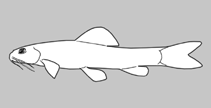
Raios dorsais moles (total) : 9; Raios anais moles: 7; Vértebras: 38 - 39. This species can be distinguished from its congeners by this set of characters: the most elongated body, body depth/SL 8.62-10.68% (vs. 11.70-16.55%); eyeless; caudal fin forked; well-developed adipose crests on caudal peduncle; body naked and de-pigmented. It is similar to O. translucens by lacking eyes and with forked caudal fin, but differs from the latter by the appearance of anterior nostril (long nostril tube and barbel of the anterior nostril, 18.6-26.3% HL) and caudal crests (adipose and not transparent) as well as more counts of vertebrae (4+38-39 vs. 4+32) (Ref. 88136).
Ciclo de vida e comportamento de acasalamento
Maturidade | Reprodução | Desova | Ovos | Fecundidade | Larvas
Tang, L., Y. Zhao and C. Zhang, 2012. A new blind loach, Oreonectes elongatus sp. nov. (Cypriniformes: Balitoridae) from Guangxi, China. Environ. Biol. Fishes 93:483-490. (Ref. 88136)
Categoria na Lista Vermelha da IUCN (Ref. 130435: Version 2025-2 (Global))
Ameaça para o homem
Harmless
Utilização humana
Ferramentas
Relatórios especiais
Descarregue XML
Fontes da internet
Estimativas baseadas em modelos
Índice de diversidade filogenética (Ref.
82804): PD
50 = 0.5000 [Uniqueness, from 0.5 = low to 2.0 = high].
Bayesian length-weight: a=0.00724 (0.00352 - 0.01491), b=3.01 (2.84 - 3.18), in cm total length, based on LWR estimates for this (Sub)family-body shape (Ref.
93245).
Nível Trófico (Ref.
69278): 2.8 ±0.3 se; based on size and trophs of closest relatives
Vulnerabilidade da pesca (Ref.
59153): Low vulnerability (10 of 100).
🛈