>
Cypriniformes (Carps) >
Nemacheilidae (Brook loaches)
Etymology: Oreonectes: Greek, oreos = mountain + Greek, nekton = swimmer (Ref. 45335); elongatus: Named from Latin word meaning elongated.
Entorno: milieu / zona climática / rango de profundidad / gama de distribución
Ecología
; agua dulce demersal. Tropical
Asia: Guangxi, China.
Tamaño / Peso / Edad
Madurez: Lm ? range ? - ? cm
Max length : 7.8 cm SL macho / no sexado; (Ref. 88136)
Descripción breve
Claves de identificación | Morfología | Morfometría
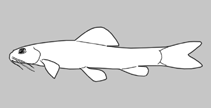
Radios blandos dorsales (total) : 9; Radios blandos anales: 7; Vértebra: 38 - 39. This species can be distinguished from its congeners by this set of characters: the most elongated body, body depth/SL 8.62-10.68% (vs. 11.70-16.55%); eyeless; caudal fin forked; well-developed adipose crests on caudal peduncle; body naked and de-pigmented. It is similar to O. translucens by lacking eyes and with forked caudal fin, but differs from the latter by the appearance of anterior nostril (long nostril tube and barbel of the anterior nostril, 18.6-26.3% HL) and caudal crests (adipose and not transparent) as well as more counts of vertebrae (4+38-39 vs. 4+32) (Ref. 88136).
Ciclo vital y comportamiento de apareamiento
Madurez | Reproducción | Puesta | Huevos | Fecundidad | Larva
Tang, L., Y. Zhao and C. Zhang, 2012. A new blind loach, Oreonectes elongatus sp. nov. (Cypriniformes: Balitoridae) from Guangxi, China. Environ. Biol. Fishes 93:483-490. (Ref. 88136)
Situación en la Lista Roja de la UICN (Ref. 130435: Version 2025-2 (Global))
Amenaza para el ser humano
Harmless
Usos humanos
Herramientas
Informes especiales
Descargar XML
Fuentes de Internet
Estimaciones basadas en modelos
Índice de diversidad filogenética (Referencia
82804): PD
50 = 0.5000 [Uniqueness, from 0.5 = low to 2.0 = high].
Bayesian length-weight: a=0.00724 (0.00352 - 0.01491), b=3.01 (2.84 - 3.18), in cm total length, based on LWR estimates for this (Sub)family-body shape (Ref.
93245).
Nivel trófico (Referencia
69278): 2.8 ±0.3 se; based on size and trophs of closest relatives
Vulnerabilidad pesquera (Ref.
59153): Low vulnerability (10 of 100).
🛈