>
Siluriformes (Catfishes) >
Auchenoglanididae (Flatnose catfishes)
Etymology: Parauchenoglanis: Greek, para = near + Greek, auchen = neck + Greek, glanis = a fish that can eat the bait without touching the hook; a cat fish (Ref. 45335); megalasma: Name from Greek ‘megalasma’ derived from ‘mega’ meaning large and ‘melasma’ meaning black spot, referring to the distinct large blotches along the lateral line present in this species.
Ambiente: milieu / zona climática / intervalo de profundidade / gama de distribuição
Ecologia
; Água doce bentopelágico. Tropical
Africa: Angola.
Tamanho / Peso / Idade
Maturidade: Lm ? range ? - ? cm
Max length : 7.3 cm SL macho/indeterminado; (Ref. 132425)
Descrição breve
Chaves de identificação | Morfologia | Morfometria
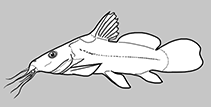
Raios dorsais moles (total) : 7; Raios anais moles: 9; Vértebras: 32 - 33. This species is distinguished from its congeners ahli, altipinnis, balayi, buettikoferi, longiceps, monkei, pantherinus, punctatus by the presence of vertical rows of blotches (vs. vertical rows of spots or bands in monkei, zebratus) and further differs from these species by a partly round snout (vs. bluntly triangular); differs from stiassnyae with truncated caudal fin (vs. rounded), dorsolaterally positioned eyes (vs. dorsally), and spotted fins (vs. unspotted pectoral, pelvic, and anal fins); it differs from all other species except ernstswartzi by its body having vertical rows of blotches with smaller blotches between them (vs. body with vertical rows of spots or bars and spots between them in ngamensis, lueleensis or absent background spots in patersoni, dolichorhinus, luendaensis, chiumbeensis); differs further differentiated from ernstswartzi by the vertical rows of blotches not extending onto adipose fin (vs. rows extending onto adipose fin), eyes situated dorsolaterally (vs. eyes situated dorsally), and deeper body depth, 18.2%-19.9% SL (vs. shallow body depth, 15.0%-17.4% SL); differs luendaensis by the spotted head and fins (vs. unspotted); differs further from luendaensis, chiumbeensis by the relatively long predorsal length, 40.7%-41.9% SL (vs. shorter, 37.9%-40.1% SL in luendaensisand 35.6%-40.8% SL in chiumbeensis); differs further chiumbeensis by its longer adipose fin, 35.6%-36.9% SL (vs. shorter, 26.0%-34.9% SL) (Ref. 132425).
Cross section: oval.
Ciclo de vida e comportamento de acasalamento
Maturidade | Reprodução | Desova | Ovos | Fecundidade | Larvas
Sithole, Y., E.J.W.M.N. Vreven, P.H.N. Bragança, T. Musschoot and A. Chakona, 2024. Nine in one: integrative taxonomic evidence of hidden species diversity in the widespread Zambezi grunter, Parauchenoglanis ngamensis (Siluriformes: Auchenoglanididae), from southern and south-central Africa. Zool. J. Linn. Soc. 202:1-33. (Ref. 132425)
Categoria na Lista Vermelha da IUCN (Ref. 130435: Version 2025-2 (Global))
Ameaça para o homem
Harmless
Utilização humana
Pescarias: pouco comercial
Ferramentas
Relatórios especiais
Descarregue XML
Fontes da internet
Estimativas baseadas em modelos
Índice de diversidade filogenética (Ref.
82804): PD
50 = 0.5000 [Uniqueness, from 0.5 = low to 2.0 = high].
Bayesian length-weight: a=0.00525 (0.00219 - 0.01260), b=3.09 (2.87 - 3.31), in cm total length, based on LWR estimates for this (Sub)family-body shape (Ref.
93245).
Nível Trófico (Ref.
69278): 3.4 ±0.5 se; based on size and trophs of closest relatives
Resiliência (Ref.
120179): Elevada, tempo mínimo de duplicação da população menor que 15 meses (Preliminary K or Fecundity.).
Vulnerabilidade da pesca (Ref.
59153): Low vulnerability (10 of 100).
🛈