>
Siluriformes (Catfishes) >
Auchenoglanididae (Flatnose catfishes)
Etymology: Parauchenoglanis: Greek, para = near + Greek, auchen = neck + Greek, glanis = a fish that can eat the bait without touching the hook; a cat fish (Ref. 45335); megalasma: Name from Greek ‘megalasma’ derived from ‘mega’ meaning large and ‘melasma’ meaning black spot, referring to the distinct large blotches along the lateral line present in this species.
البيئة: الوسط / المنطقة المناخية / نطاق العمق / نطاق التوزيع
البيئة
; المياه العذبة قاعية التغذية و المعيشة. Tropical
Africa: Angola.
الحجم / وزن / العمر
النضج: Lm ? range ? - ? cm
Max length : 7.3 cm SL ذكر/ مختلط الجنس; (Ref. 132425)
وصف مختصر
مفاتيح التعريف | الوصف الخارجي | قياسات المظهر الخارجي
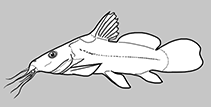
الأشعة الظهرية الناعمة (المجموع) : 7; أشعه شرجية لينه: 9; فقرات: 32 - 33. This species is distinguished from its congeners ahli, altipinnis, balayi, buettikoferi, longiceps, monkei, pantherinus, punctatus by the presence of vertical rows of blotches (vs. vertical rows of spots or bands in monkei, zebratus) and further differs from these species by a partly round snout (vs. bluntly triangular); differs from stiassnyae with truncated caudal fin (vs. rounded), dorsolaterally positioned eyes (vs. dorsally), and spotted fins (vs. unspotted pectoral, pelvic, and anal fins); it differs from all other species except ernstswartzi by its body having vertical rows of blotches with smaller blotches between them (vs. body with vertical rows of spots or bars and spots between them in ngamensis, lueleensis or absent background spots in patersoni, dolichorhinus, luendaensis, chiumbeensis); differs further differentiated from ernstswartzi by the vertical rows of blotches not extending onto adipose fin (vs. rows extending onto adipose fin), eyes situated dorsolaterally (vs. eyes situated dorsally), and deeper body depth, 18.2%-19.9% SL (vs. shallow body depth, 15.0%-17.4% SL); differs luendaensis by the spotted head and fins (vs. unspotted); differs further from luendaensis, chiumbeensis by the relatively long predorsal length, 40.7%-41.9% SL (vs. shorter, 37.9%-40.1% SL in luendaensisand 35.6%-40.8% SL in chiumbeensis); differs further chiumbeensis by its longer adipose fin, 35.6%-36.9% SL (vs. shorter, 26.0%-34.9% SL) (Ref. 132425).
Cross section: oval.
دورة الحياة وسلوك التزاوج
النضج | التكاثر | وضع البيض | بيض | الخصوبة | اليرقات
Sithole, Y., E.J.W.M.N. Vreven, P.H.N. Bragança, T. Musschoot and A. Chakona, 2024. Nine in one: integrative taxonomic evidence of hidden species diversity in the widespread Zambezi grunter, Parauchenoglanis ngamensis (Siluriformes: Auchenoglanididae), from southern and south-central Africa. Zool. J. Linn. Soc. 202:1-33. (Ref. 132425)
حالة القائمة الحمراء للاتحاد الدولي لحفظ الطبيعة والموارد الطبيعية (Ref. 130435: Version 2025-2 (Global))
استخدامات بشرية
مصائد: غير مهمة تجارياً
أدوات
تقارير خاصة
تنزيل XML
مصادر علي الأنترنت
تقديرات تستند إلى النماذج
مؤشر التنوع الشُعبي الوراثي (مرجع
82804): PD
50 = 0.5000 [Uniqueness, from 0.5 = low to 2.0 = high].
Bayesian length-weight: a=0.00525 (0.00219 - 0.01260), b=3.09 (2.87 - 3.31), in cm total length, based on LWR estimates for this (Sub)family-body shape (Ref.
93245).
مستوى غذائي (مرجع
69278): 3.4 ±0.5 se; based on size and trophs of closest relatives
المرونه (مرجع
120179): عالي, الحد الزمني الأدني لتضاعف عدد أفراد المجتمع أقل من 15 شهر (Preliminary K or Fecundity.).
ضعف الصيد (Ref.
59153): Low vulnerability (10 of 100).
🛈