>
Ovalentaria/misc (Various families in series Ovalentaria) >
Pomacentridae (Damselfishes) > Pomacentrinae
Etymology: Pomacentrus: Greek, poma, -atos = cover, operculum + Greek, kentron = sting (Ref. 45335); nigriradiatus: Named for the dark rays on the posterior sections of the median fins; a compound adjective.
Ambiente: milieu / zona climática / intervalo de profundidade / gama de distribuição
Ecologia
marinhas associadas(os) a recifes; intervalo de profundidade 8 - 20 m (Ref. 114927). Tropical
Distribuição
Territórios | Áreas FAO | Ecossistemas | Ocorrências | Mapa dos pontos | Introduções | Faunafri
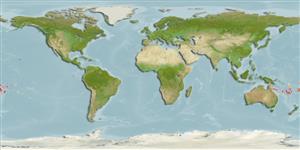
South Pacific: New Caledonia to American Samoa, including Loyalty Islands, Vanuatu, Rotuma, Wallis, and Samoa (formerly Western Samoa).
Tamanho / Peso / Idade
Maturidade: Lm ? range ? - ? cm
Max length : 7.4 cm SL macho/indeterminado; (Ref. 114927)
Descrição breve
Chaves de identificação | Morfologia | Morfometria
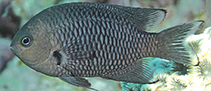
Espinhos dorsais (total) : 13; Raios dorsais moles (total) : 14 - 15; Espinhos anais: 2; Raios anais moles: 14 - 15; Vértebras: 26. This species is distinguished by the following characters: D XIII,14-15; A II,14-15; pectoral-fin rays usually 17-18 (rarely 17); tubed lateral-line scales 17-19 (rarely 19); total gill rakers on first arch 22-24 (rarely 22); body depth 2.0-2.2 in SL; a patch of scales usually present on preorbital and a single row of scales on suborbital, continuing around posterior margin of eye; color in life generally gray to gray brown with thick black or dark-brown scale margins producing a network pattern; a black spot covers entire pectoral-fin base; inner side of pectoral-fin axil tannish to pale gray; median fins dark gray with translucent portion posteriorly showing conspicuous contrasting blackish rays; dorsal scleral surface of eye either uniform grayish or with a few blue markings. This species differs from other members of the philippinus species complex by the distinct color pattern features, particularly the obvious contrasting dark fin rays on the posterior sections of the dorsal, anal, and caudal fins; also differs from P. albiaxillaris, P. flavoaxillaris, and P. magniseptus in usually having at least a few scales on the preorbital (lacking in three of the many type specimens) (Ref, 114927).
Body shape (shape guide): short and / or deep; Cross section: compressed.
Ciclo de vida e comportamento de acasalamento
Maturidade | Reprodução | Desova | Ovos | Fecundidade | Larvas
Allen, G.R., M.V. Erdmann and P.D. Pertiwi, 2017. Descriptions of four new species of damselfishes (Pomacentridae) in the Pomacentrus philippinus complex from the tropical western Pacific Ocean. J. Ocean Sci. Found. 25:47-76. (Ref. 114927)
Categoria na Lista Vermelha da IUCN (Ref. 130435: Version 2025-2 (Global))
Ameaça para o homem
Harmless
Utilização humana
Ferramentas
Relatórios especiais
Descarregue XML
Fontes da internet
Estimativas baseadas em modelos
Índice de diversidade filogenética (Ref.
82804): PD
50 = 0.5000 [Uniqueness, from 0.5 = low to 2.0 = high].
Bayesian length-weight: a=0.02399 (0.01134 - 0.05074), b=2.98 (2.81 - 3.15), in cm total length, based on LWR estimates for this Genus-body shape (Ref.
93245).
Nível Trófico (Ref.
69278): 2.7 ±0.3 se; based on size and trophs of closest relatives
Resiliência (Ref.
120179): Elevada, tempo mínimo de duplicação da população menor que 15 meses (Preliminary K or Fecundity.).
Vulnerabilidade da pesca (Ref.
59153): Low vulnerability (10 of 100).
🛈