>
Ovalentaria/misc (Various families in series Ovalentaria) >
Pomacentridae (Damselfishes) > Pomacentrinae
Etymology: Pomacentrus: Greek, poma, -atos = cover, operculum + Greek, kentron = sting (Ref. 45335); nigriradiatus: Named for the dark rays on the posterior sections of the median fins; a compound adjective.
Entorno: milieu / zona climática / rango de profundidad / gama de distribución
Ecología
marino asociado a arrecife; rango de profundidad 8 - 20 m (Ref. 114927). Tropical
Distribución
Territorios | Áreas FAO | Ecosistemas | Ocurrencias, apariciones | Mapa de puntos | Introducciones | Faunafri
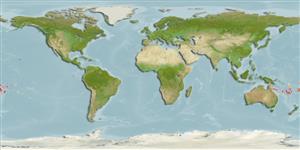
South Pacific: New Caledonia to American Samoa, including Loyalty Islands, Vanuatu, Rotuma, Wallis, and Samoa (formerly Western Samoa).
Tamaño / Peso / Edad
Madurez: Lm ? range ? - ? cm
Max length : 7.4 cm SL macho / no sexado; (Ref. 114927)
Descripción breve
Claves de identificación | Morfología | Morfometría
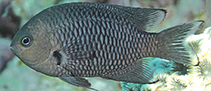
Espinas dorsales (total) : 13; Radios blandos dorsales (total) : 14 - 15; Espinas anales: 2; Radios blandos anales: 14 - 15; Vértebra: 26. This species is distinguished by the following characters: D XIII,14-15; A II,14-15; pectoral-fin rays usually 17-18 (rarely 17); tubed lateral-line scales 17-19 (rarely 19); total gill rakers on first arch 22-24 (rarely 22); body depth 2.0-2.2 in SL; a patch of scales usually present on preorbital and a single row of scales on suborbital, continuing around posterior margin of eye; color in life generally gray to gray brown with thick black or dark-brown scale margins producing a network pattern; a black spot covers entire pectoral-fin base; inner side of pectoral-fin axil tannish to pale gray; median fins dark gray with translucent portion posteriorly showing conspicuous contrasting blackish rays; dorsal scleral surface of eye either uniform grayish or with a few blue markings. This species differs from other members of the philippinus species complex by the distinct color pattern features, particularly the obvious contrasting dark fin rays on the posterior sections of the dorsal, anal, and caudal fins; also differs from P. albiaxillaris, P. flavoaxillaris, and P. magniseptus in usually having at least a few scales on the preorbital (lacking in three of the many type specimens) (Ref, 114927).
Body shape (shape guide): short and / or deep; Cross section: compressed.
Ciclo vital y comportamiento de apareamiento
Madurez | Reproducción | Puesta | Huevos | Fecundidad | Larva
Allen, G.R., M.V. Erdmann and P.D. Pertiwi, 2017. Descriptions of four new species of damselfishes (Pomacentridae) in the Pomacentrus philippinus complex from the tropical western Pacific Ocean. J. Ocean Sci. Found. 25:47-76. (Ref. 114927)
Situación en la Lista Roja de la UICN (Ref. 130435: Version 2025-2 (Global))
Amenaza para el ser humano
Harmless
Usos humanos
Herramientas
Informes especiales
Descargar XML
Fuentes de Internet
Estimaciones basadas en modelos
Índice de diversidad filogenética (Referencia
82804): PD
50 = 0.5000 [Uniqueness, from 0.5 = low to 2.0 = high].
Bayesian length-weight: a=0.02399 (0.01134 - 0.05074), b=2.98 (2.81 - 3.15), in cm total length, based on LWR estimates for this Genus-body shape (Ref.
93245).
Nivel trófico (Referencia
69278): 2.7 ±0.3 se; based on size and trophs of closest relatives
Resiliencia (Referencia
120179): Alto, población duplicada en un tiempo mínimo inferior a 15 meses (Preliminary K or Fecundity.).
Vulnerabilidad pesquera (Ref.
59153): Low vulnerability (10 of 100).
🛈