Elasmobranchii (tubarões e raias) (sharks and rays) >
Carcharhiniformes (Ground sharks) >
Atelomycteridae (Coloured catsharks)
Etymology: Schroederichthys: In honor of American ichthyologist William C. Schroeder (1895-1977), Woods Hole Oceanographic Institution, for his pioneering work (with Henry B. Bigelow) on cartilaginous fishes; ichthyos (Gr.), fish (See ETYFish); bivius: bi-, from bis (L.), two; via (L.), way or passage, etymology not explained, perhaps referring to double-valved nostrils, with incurrent and excurrent apertures (See ETYFish).
Eponymy: William Charles Schroeder (1894–1977) was an American oceanographer and ichthyologist. [...] (Ref. 128868), visit book page.
More on authors: Müller & Henle.
Ambiente: milieu / zona climática / intervalo de profundidade / gama de distribuição
Ecologia
marinhas demersal; intervalo de profundidade 14 - 78 m (Ref. 244). Subtropical; 23°S - 56°S
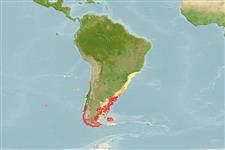
Southeast Pacific and Southwest Atlantic: central Chile to the Straits of Magellan and Argentina.
Comprimento na primeira maturidade / Tamanho / Peso / Idade
Maturidade: Lm ?, range 40 - ? cm
Max length : 70.0 cm TL macho/indeterminado; (Ref. 244)
Descrição breve
Chaves de identificação | Morfologia | Morfometria
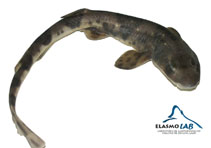
A common inshore to offshore shark found on the continental shelf. Oviparous (Ref. 50449). Dental sexual dimorphism exists, with adult males having teeth at least twice as high as adult females as well as much longer and narrower mouths.
Ciclo de vida e comportamento de acasalamento
Maturidade | Reprodução | Desova | Ovos | Fecundidade | Larvas
Oviparous, paired eggs are laid. Embryos feed solely on yolk (Ref. 50449). Sexual dimorphism is evident in dentition of male species (Ref. 49562). Males have longer teeth with fewer cusps than females (Ref. 51093) to make 'courtship biting' more effective (Ref. 49562).
Compagno, L.J.V., 1984. FAO Species Catalogue. Vol. 4. Sharks of the world. An annotated and illustrated catalogue of shark species known to date. Part 2 - Carcharhiniformes. FAO Fish. Synop. 125(4/2):251-655. Rome: FAO. (Ref. 244)
Categoria na Lista Vermelha da IUCN (Ref. 130435: Version 2025-2 (Global))
Ameaça para o homem
Harmless
Utilização humana
Pescarias: sem interesse
Ferramentas
Relatórios especiais
Descarregue XML
Fontes da internet
Estimativas baseadas em modelos
Temperatura preferida (Ref.
123201): 6.4 - 15.6, mean 10.6 °C (based on 202 cells).
Índice de diversidade filogenética (Ref.
82804): PD
50 = 0.5314 [Uniqueness, from 0.5 = low to 2.0 = high].
Bayesian length-weight: a=0.00389 (0.00180 - 0.00842), b=3.12 (2.94 - 3.30), in cm total length, based on all LWR estimates for this body shape (Ref.
93245).
Nível Trófico (Ref.
69278): 3.8 ±0.3 se; based on diet studies.
Resiliência (Ref.
120179): Muito baixo, tempo mínimo de duplicação da população maior que 14 anos (Fec=2).
Vulnerabilidade da pesca (Ref.
59153): Moderate to high vulnerability (48 of 100).
🛈
Nutrientes (Ref.
124155): Calcium = 27.1 [4.5, 147.7] mg/100g; Iron = 0.723 [0.192, 2.131] mg/100g; Protein = 16.1 [13.3, 20.4] %; Omega3 = 0.18 [0.08, 0.39] g/100g; Selenium = 19.3 [5.8, 54.7] μg/100g; VitaminA = 10.6 [3.7, 29.9] μg/100g; Zinc = 0.636 [0.303, 1.164] mg/100g (wet weight); based on
nutrient studies.