Elasmobranchii (Haie und Rochen) (sharks and rays) >
Carcharhiniformes (Ground sharks) >
Atelomycteridae (Coloured catsharks)
Etymology: Schroederichthys: In honor of American ichthyologist William C. Schroeder (1895-1977), Woods Hole Oceanographic Institution, for his pioneering work (with Henry B. Bigelow) on cartilaginous fishes; ichthyos (Gr.), fish (See ETYFish); bivius: bi-, from bis (L.), two; via (L.), way or passage, etymology not explained, perhaps referring to double-valved nostrils, with incurrent and excurrent apertures (See ETYFish).
Eponymy: William Charles Schroeder (1894–1977) was an American oceanographer and ichthyologist. [...] (Ref. 128868), visit book page.
More on authors: Müller & Henle.
Umwelt: Milieu / Klimazone / Tiefenbereich / Verbreitungsgebiet
Ökologie
seewasser demersal; tiefenbereich 14 - 78 m (Ref. 244). Subtropical; 23°S - 56°S
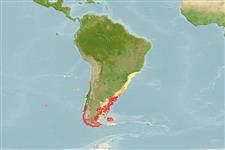
Southeast Pacific and Southwest Atlantic: central Chile to the Straits of Magellan and Argentina.
Länge bei der ersten Reifung / Größe / Gewicht / Alter
Geschlechtsreife: Lm ?, range 40 - ? cm
Max length : 70.0 cm TL Männchen/unbestimmt; (Ref. 244)
Kurzbeschreibung
Bestimmungsschlüssel | Morphologie | Morphometrie
A common inshore to offshore shark found on the continental shelf. Oviparous (Ref. 50449). Dental sexual dimorphism exists, with adult males having teeth at least twice as high as adult females as well as much longer and narrower mouths.
Oviparous, paired eggs are laid. Embryos feed solely on yolk (Ref. 50449). Sexual dimorphism is evident in dentition of male species (Ref. 49562). Males have longer teeth with fewer cusps than females (Ref. 51093) to make 'courtship biting' more effective (Ref. 49562).
Compagno, L.J.V., 1984. FAO Species Catalogue. Vol. 4. Sharks of the world. An annotated and illustrated catalogue of shark species known to date. Part 2 - Carcharhiniformes. FAO Fish. Synop. 125(4/2):251-655. Rome: FAO. (Ref. 244)
IUCN Rote Liste Status (Ref. 130435: Version 2025-2 (Global))
Bedrohung für Menschen
Harmless
Nutzung durch Menschen
Fischereien: nicht kommerziell
Tools
Zusatzinformationen
Download XML
Internet Quellen
Schätzungen auf der Grundlage von Modellen
Bevorzugte Temperatur (Ref.
123201): 6.4 - 15.6, mean 10.6 °C (based on 202 cells).
Phylogenetischer Diversitätsindex (Ref.
82804): PD
50 = 0.5314 [Uniqueness, from 0.5 = low to 2.0 = high].
Bayesian length-weight: a=0.00389 (0.00180 - 0.00842), b=3.12 (2.94 - 3.30), in cm total length, based on all LWR estimates for this body shape (Ref.
93245).
Trophische Ebene (Ref.
69278): 3.8 ±0.3 se; based on diet studies.
Widerstandsfähigkeit (Ref.
120179): sehr niedrig, Verdopplung der Population dauert mehr als 14 Jahre. (Fec=2).
Anfälligkeit der Fischerei (Ref.
59153): Moderate to high vulnerability (48 of 100).
🛈
Nährstoffe (Ref.
124155): Calcium = 27.1 [4.5, 147.7] mg/100g; Iron = 0.723 [0.192, 2.131] mg/100g; Protein = 16.1 [13.3, 20.4] %; Omega3 = 0.18 [0.08, 0.39] g/100g; Selenium = 19.3 [5.8, 54.7] μg/100g; VitaminA = 10.6 [3.7, 29.9] μg/100g; Zinc = 0.636 [0.303, 1.164] mg/100g (wet weight); based on
nutrient studies.