Classificação / Nomes
Nomes comuns | Sinónimos | Catalog of Fishes(Género, Espécies) | ITIS | CoL | WoRMS | Cloffa
>
Cypriniformes (Carps) >
Acheilognathidae (Bitterlings)
Etymology: Tanakia: Perhaps from a Swahili word, tanaki = reservoir; due to its habitat?; latimarginata: Derived from the Latin latus (broad), and marginatus (margined), in allusion to the broad black margin of the anal-fin of mature males. An adjective.
Eponymy: Dr Shigeho Tanaka (1878–1974) was a Japanese ichthyologist who was Professor of Zoology at the Imperial University, Tokyo. [...] (Ref. 128868), visit book page.
Ambiente: milieu / zona climática / intervalo de profundidade / gama de distribuição
Ecologia
; Água doce bentopelágico. Subtropical
Asia: Nakdong River drainage in South Korea.
Tamanho / Peso / Idade
Maturidade: Lm ? range ? - ? cm
Max length : 7.5 cm SL macho/indeterminado; (Ref. 97360); 6.4 cm SL (female)
Descrição breve
Chaves de identificação | Morfologia | Morfometria
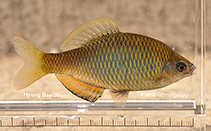
Raios dorsais moles (total) : 11; Raios anais moles: 12 - 13. Tanakia latimarginata can be readily diagnosed from its phylogenetically closest congener T. lanceolata by the following characters: body generally brownish laterally in life (vs. generally silvery laterally); dorsal fin of mature males in life with an ivory to reddish-orange band distally (vs. a pale pink to pinky red band distally); and anal-fin of mature males with distal margin black, two ivory to orange bands separated by an indistinct dark band of similar width (vs. distal margin red to pink, an indistinct black band proximally). It differs from T. koreensis by the width of the black distal margin of the anal-fin of mature males (greater than the pupil diameter posteriorly to the mid-point of the fin vs. greater than or as wide as the pupil diameter posteriorly only to the second or third branched soft fin-ray), by having a light colored ovipositor in mature females (light grey to yellowish-grey vs. brownish-grey to black) and by the shape of the fifth infraorbital bone (irregularly shaped, widest dorsally vs. rectangular with uniform width along entire length or triangular, widest ventrally). It can be further distinguished from T. lanceolata and T. koreensis by having a parietal branch of the supraorbital sensory canal reaching to or extending past of the border between the frontal and parietal (vs. parietal branch of supraorbital sensory canal reaching to or extending past the border between the frontal and pterotic, without contact to the parietal) (Ref. 97360).
Body shape (shape guide): fusiform / normal.
Occurs mostly in clear and shallow (40-120 cm deep) low to medium-gradient large creeks to medium rivers, over coarse sand to pebble substrates. Inhabits backwaters or shallow pools near vegetation from autumn to spring. Large individual are usually collected in rock- and gravel-bottomed riffles during summer. The type series was collected together with the congener T. lanceolata, along with the following species in the subfamily Acheilognathinae: Acheilognathus macropterus, A. majusculus, A. rhombeus, A. yamatsutae, Rhodeus ocellatus, R. notatus and R. sinensis. Spawns from April to August. Spawning males aggresively defend a territory around a mussel-spawning site. Also collected together with unionid mussels (Unio douglasiae, Anodonta woodiana, Lanceolaria grayana and Solenaia triangularis, though the major host mussels are still not known (Ref. 97360).
Ciclo de vida e comportamento de acasalamento
Maturidade | Reprodução | Desova | Ovos | Fecundidade | Larvas
Kim, D., H.-B. Jeon and H.Y. Suk, 2014. Tanakia latimarginata, a new species of bitterling from the Nakdong River, South Korea (Teleostei: Cyprinidae). Ichthyol. Explor. Freshwat. 25(1):59-68. (Ref. 97360)
Categoria na Lista Vermelha da IUCN (Ref. 130435: Version 2025-2 (Global))
Ameaça para o homem
Harmless
Utilização humana
Ferramentas
Relatórios especiais
Descarregue XML
Fontes da internet
Estimativas baseadas em modelos
Índice de diversidade filogenética (Ref.
82804): PD
50 = 0.5078 [Uniqueness, from 0.5 = low to 2.0 = high].
Bayesian length-weight: a=0.01047 (0.00482 - 0.02276), b=3.10 (2.92 - 3.28), in cm total length, based on LWR estimates for this (Sub)family-body shape (Ref.
93245).
Nível Trófico (Ref.
69278): 2.2 ±0.1 se; based on size and trophs of closest relatives
Resiliência (Ref.
120179): Elevada, tempo mínimo de duplicação da população menor que 15 meses (Preliminary K or Fecundity.).
Vulnerabilidade da pesca (Ref.
59153): Low vulnerability (10 of 100).
🛈