Classification / Noms
Noms communs | Synonymes | Catalog of Fishes(Genre, Espèce) | ITIS | CoL | WoRMS | Cloffa
>
Cypriniformes (Carps) >
Acheilognathidae (Bitterlings)
Etymology: Tanakia: Perhaps from a Swahili word, tanaki = reservoir; due to its habitat?; latimarginata: Derived from the Latin latus (broad), and marginatus (margined), in allusion to the broad black margin of the anal-fin of mature males. An adjective.
Eponymy: Dr Shigeho Tanaka (1878–1974) was a Japanese ichthyologist who was Professor of Zoology at the Imperial University, Tokyo. [...] (Ref. 128868), visit book page.
Environnement : milieu / zone climatique / profondeur / gamme de distribution
Écologie
; eau douce benthopélagique. Subtropical
Asia: Nakdong River drainage in South Korea.
Taille / Poids / Âge
Maturité: Lm ? range ? - ? cm
Max length : 7.5 cm SL mâle / non sexé; (Ref. 97360); 6.4 cm SL (female)
Description synthétique
Clés d'identification | Morphologie | Morphométrie
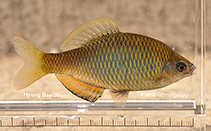
Rayons mous dorsaux (Total) : 11; Rayons mous anaux: 12 - 13. Tanakia latimarginata can be readily diagnosed from its phylogenetically closest congener T. lanceolata by the following characters: body generally brownish laterally in life (vs. generally silvery laterally); dorsal fin of mature males in life with an ivory to reddish-orange band distally (vs. a pale pink to pinky red band distally); and anal-fin of mature males with distal margin black, two ivory to orange bands separated by an indistinct dark band of similar width (vs. distal margin red to pink, an indistinct black band proximally). It differs from T. koreensis by the width of the black distal margin of the anal-fin of mature males (greater than the pupil diameter posteriorly to the mid-point of the fin vs. greater than or as wide as the pupil diameter posteriorly only to the second or third branched soft fin-ray), by having a light colored ovipositor in mature females (light grey to yellowish-grey vs. brownish-grey to black) and by the shape of the fifth infraorbital bone (irregularly shaped, widest dorsally vs. rectangular with uniform width along entire length or triangular, widest ventrally). It can be further distinguished from T. lanceolata and T. koreensis by having a parietal branch of the supraorbital sensory canal reaching to or extending past of the border between the frontal and parietal (vs. parietal branch of supraorbital sensory canal reaching to or extending past the border between the frontal and pterotic, without contact to the parietal) (Ref. 97360).
Body shape (shape guide): fusiform / normal.
Occurs mostly in clear and shallow (40-120 cm deep) low to medium-gradient large creeks to medium rivers, over coarse sand to pebble substrates. Inhabits backwaters or shallow pools near vegetation from autumn to spring. Large individual are usually collected in rock- and gravel-bottomed riffles during summer. The type series was collected together with the congener T. lanceolata, along with the following species in the subfamily Acheilognathinae: Acheilognathus macropterus, A. majusculus, A. rhombeus, A. yamatsutae, Rhodeus ocellatus, R. notatus and R. sinensis. Spawns from April to August. Spawning males aggresively defend a territory around a mussel-spawning site. Also collected together with unionid mussels (Unio douglasiae, Anodonta woodiana, Lanceolaria grayana and Solenaia triangularis, though the major host mussels are still not known (Ref. 97360).
Cycle de vie et comportement reproducteur
Maturité | Reproduction | Frai | Œufs | Fécondité | Larves
Kim, D., H.-B. Jeon and H.Y. Suk, 2014. Tanakia latimarginata, a new species of bitterling from the Nakdong River, South Korea (Teleostei: Cyprinidae). Ichthyol. Explor. Freshwat. 25(1):59-68. (Ref. 97360)
Statut dans la liste rouge de l'IUCN (Ref. 130435: Version 2025-2 (Global))
Menace pour l'homme
Harmless
Utilisations par l'homme
Outils
Articles particuliers
Télécharger en XML
Sources Internet
Estimations basées sur des modèles
Indice de diversité phylogénétique (Réf.
82804): PD
50 = 0.5078 [Uniqueness, from 0.5 = low to 2.0 = high].
Bayesian length-weight: a=0.01047 (0.00482 - 0.02276), b=3.10 (2.92 - 3.28), in cm total length, based on LWR estimates for this (Sub)family-body shape (Ref.
93245).
Niveau trophique (Réf.
69278): 2.2 ±0.1 se; based on size and trophs of closest relatives
Résilience (Réf.
120179): Haut, temps minimum de doublement de population inférieur à 15 mois (Preliminary K or Fecundity.).
Vulnérabilité de la pêche (Ref.
59153): Low vulnerability (10 of 100).
🛈