Ambiente: milieu / zona climatica / distribuzione batimetrica / gamma di distribuzione
Ecologia
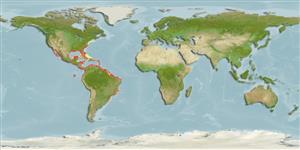
marino; salmastro associati a barriera corallina; distribuzione batimetrica 0 - 50 m (Ref. 96339). Subtropical; 43°N - 35°S, 116°W - 31°W
Western Atlantic: Maine, USA and northern Gulf of Mexico to Uruguay; throughout most of the West Indies (Ref. 3277). Absent from the Bahamas (Ref. 26938). Eastern Pacific: Baja California, Mexico to Ecuador (Ref. 9283). Two subspecies exists (Ref. 3277): Oligoplites saurus saurus (western Atlantic population) and Oligoplites saurus inornatus (eastern Pacific population).
Dimensione / Peso / Età
Maturità: Lm ? range ? - ? cm
Max length : 35.0 cm TL maschio/sesso non determinato; (Ref. 5217); common length : 27.0 cm TL maschio/sesso non determinato; (Ref. 5217); peso massimo pubblicato: 287.00 g (Ref. 3277)
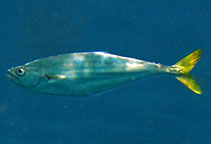
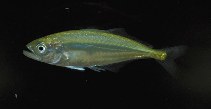
Spine dorsali (totale) : 5 - 6; Raggi dorsali molli (totale) : 19 - 21; Spine anali: 2 - 3; Raggi anali molli: 18 - 21. Body elongate and strongly compressed (depth from 3.5 to 4.4 times in standard length); posterior end of upper jaw reaching posterior rim of eye; upper jaw teeth small and villiform; lower branch of first gill arch with 14 to 18 gill rakers; scales small but visible, needle-shaped, embedded in the skin; back blue green; flanks and belly silvery to white, sometimes with yellow or golden highlights; pectoral and caudal fins yellowish (Ref. 55763); Dorsal fin has 5 nearly separate spines.
Body shape (shape guide): fusiform / normal.
Adults are found inshore, usually along sandy beaches, in bays and inlets. They enter estuaries and fresh water, preferring turbid water. They occur in schools, usually large and fast moving, often leaping out of the water. Juveniles may float at the surface with tail bent and head down. Adults feed on fishes and crustaceans. The dorsal and anal spines are connected to venomous glands that can inflict painful wounds (Ref. 9283). Venom glands were not visible however, and cannot be confirmed in the specimen according to Smith and Wheeler, 2006 (Ref. 57406). Current information for this species as being dangerous need verification. Juveniles have incisor-like outer teeth and serve as cleaners for other fish; as fish grow, their teeth become conical and their diet changes (Ref. 26938). Marketed fresh and salted or dried but the flesh is not highly esteemed (Ref. 9283).
Ciclo vitale e comportamento di accoppiamento
Maturità | Riproduzione | Deposizione | Uova | Fecondità | Larve
Smith-Vaniz, W.F., 1995. Carangidae. Jureles, pámpanos, cojinúas, zapateros, cocineros, casabes, macarelas, chicharros, jorobados, medregales, pez pilota. p. 940-986. In W. Fischer, F. Krupp, W. Schneider, C. Sommer, K.E. Carpenter and V. Niem (eds.) Guia FAO para Identification de Especies para lo Fines de la Pesca. Pacifico Centro-Oriental. 3 Vols. FAO, Rome. (Ref. 9283)
Stato della Lista Rossa IUCN (Ref. 130435: Version 2025-2 (Global))
Usi umani
Pesca: scarso interesse commerciale; Pesce da pesca sportiva: si; esca: occasionally
Strumenti
Rapporti speciali
Scarica XML
Fonti Internet
Stime basate su modelli
Temperatura preferita (Fonte Biblio.
123201): 21.8 - 28, mean 25.5 °C (based on 554 cells).
Indice di diversità filogenetica (Fonte Biblio.
82804): PD
50 = 0.5312 [Uniqueness, from 0.5 = low to 2.0 = high].
Bayesian length-weight: a=0.00708 (0.00525 - 0.00954), b=2.88 (2.82 - 2.94), in cm total length, based on LWR estimates for this species (Ref.
93245).
Livello trofico (Fonte Biblio.
69278): 4.3 ±0.5 se; based on diet studies.
Resilienza (Fonte Biblio.
120179): Alto, tempo minimo di raddoppiamento della popolazione meno di 15 mesi (Preliminary K or Fecundity.).
Vulnerabilità della pesca (Ref.
59153): Low vulnerability (25 of 100).
🛈
Nutrienti (Ref.
124155): Calcium = 43.3 [17.4, 91.0] mg/100g; Iron = 0.907 [0.475, 1.732] mg/100g; Protein = 20.7 [19.6, 21.8] %; Omega3 = 0.275 [0.157, 0.475] g/100g; Selenium = 13.3 [6.0, 26.5] μg/100g; VitaminA = 63.6 [18.5, 220.9] μg/100g; Zinc = 0.738 [0.467, 1.117] mg/100g (wet weight);