>
Carangiformes (Jacks) >
Carangidae (Jacks and pompanos) > Caranginae
Etymology: Pseudocaranx: Greek, pseudes = false + French, carangue, the name of a Caribbean fish; 1836 (Ref. 45335).
More on authors: Bloch & Schneider.
Taxonomic Remarks
The species Pseudocaranx cheilio (Snyder, 1904) is considered as valid in Eschmeyer (CofF ver. Mar. 2011: Ref. 86697) following Randall (2007: Ref. 86689). The species Pseudocaranx georgianus (Cuvier, 1833) is considered as valid in CofF ver. May. 2011 following Smith-Vaniz & Jelks (2006: Ref. 76781), with Caranx luna Geoffroy Saint-Hilaire, 1817, Caranx platessa Cuvier, 1833, Caranx nobilis Macleay,1881, and Usacaranx archeyi Griffin, 1932 as synonyms. Caranx georgianus (now under Pseudocaranx is also a valid species.
Meio ambiente: milieu / Zona climática / intervalo de profundidade / faixa de distribuição
Ecologia
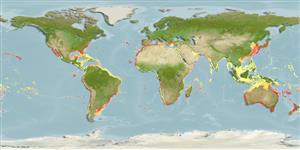
marinhas; estuarina associadas(os) a recifes; intervalo de profundidade 10 - 238 m (Ref. 58302), usually 10 - 25 m (Ref. 5288). Tropical; 40°N - 47°S
Western Atlantic: North Carolina, USA and Bermuda to southern Brazil. Eastern Atlantic: Mediterranean, Azores, Madeira, the Canary Islands, Cape Verde, Ascension and St. Helena Island. Indo-Pacific: South Africa, Japan, Hawaii (Ref. 26145), Australia, Lord Howe and Norfolk islands, New Zealand. Reported from New Caledonia (Ref. 9070).
Comprimento de primeira maturação / Tamanho / Peso / Idade
Maturidade: Lm 34.5, range 28 - 37 cm
Max length : 122 cm TL macho/indeterminado; (Ref. 4887); common length : 40.0 cm TL macho/indeterminado; (Ref. 9258); peso máx. publicado: 18.1 kg (Ref. 4887); idade máx. registrada: 49 anos (Ref. 31614)
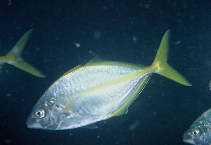
Espinhos dorsais (total) : 9; Raios dorsais (total) : 25 - 26; Espinhos anais: 3; Raios anais : 21 - 22; Vértebras: 25. Greenish blue above, silvery white below; midside of body with yellow stripe; opercle with black spot (Ref. 3197). LL with 20-26 scutes (Ref. 6390). With maxilla the rear edge sloping slightly forward to its main axis, a large, diffuse dark blotch on the operculum, and a lateral line with 57-78 scales in the curved portion and 34-46 posterior scutes (Ref. 33616).
Body shape (shape guide): fusiform / normal.
Adults occur in bays and coastal waters, including estuaries (Ref. 9563). Juveniles usually inhabit estuaries, bays and shallow continental shelf waters, while adults form schools near the sea bed on the continental shelf (Ref. 6390). Schools are found at the surface, in mid-water and on the bottom and are often associated with reefs and rough bottom (Ref. 9072). Schools are sometimes mixed with Caranx koheru and Arripis trutta (Ref. 9072). Feed on plankton by ram-filtering and suction feeding and on bottom invertebrates (Ref. 9072, 30206). Eggs are pelagic (Ref. 4233). Cultured only in Japan. (Ref. 4931). One of the best table fish 'being indeed the salmon of St. Helena' (Ref. 5288).
They are usually partial spawners, releasing eggs in small batches at intervals over a period of several weeks (Ref. 27733).
Paxton, J.R., D.F. Hoese, G.R. Allen and J.E. Hanley, 1989. Pisces. Petromyzontidae to Carangidae. Zoological Catalogue of Australia, Vol. 7. Australian Government Publishing Service, Canberra, 665 p. (Ref. 7300)
Status na Lista Vermelha da UICN (Ref. 130435: Version 2025-2 (Global))
Ameaça para os humanos
Harmless
Uso pelos humanos
Pescarias: espécies comerciais; Aquacultura: espécies comerciais; peixe esportivo: sim
Ferramentas
Relatórios especiais
Baixar XML
Fontes da internet
Estimativas baseadas em modelos
Temperatura preferida (Ref.
123201): 15.3 - 25.9, mean 22.3 °C (based on 362 cells).
Índice de diversidade filogenética (Ref.
82804): PD
50 = 0.5625 [Uniqueness, from 0.5 = low to 2.0 = high].
Bayesian length-weight: a=0.01380 (0.00852 - 0.02237), b=2.97 (2.84 - 3.10), in cm total length, based on LWR estimates for this species & (Sub)family-body (Ref.
93245).
Nível Trófico (Ref.
69278): 3.9 ±0.6 se; based on diet studies.
Resiliência (Ref.
120179): Baixo, tempo mínimo de duplicação da população 4,5 - 14 anos (Assumed K=0.06 and tm>5; tmax=49).
Prior r = 0.42, 95% CL = 0.28 - 0.63, Based on 1 data-limited stock assessment.
Vulnerabilidade da pesca (Ref.
59153): High to very high vulnerability (73 of 100).
🛈
Vulnerabilidade climática (Ref.
125649): Moderate to high vulnerability (52 of 100).
🛈
Nutrientes (Ref.
124155): Calcium = 23.5 [11.5, 45.7] mg/100g; Iron = 0.594 [0.313, 1.142] mg/100g; Protein = 19.6 [18.4, 20.9] %; Omega3 = 0.144 [0.086, 0.253] g/100g; Selenium = 52.3 [26.4, 100.4] μg/100g; VitaminA = 74 [18, 275] μg/100g; Zinc = 0.975 [0.667, 1.364] mg/100g (wet weight);