This website uses cookies to enhance your browsing experience and ensure the functionality of our site. For more detailed information about the types of cookies we use and how we protect your privacy, please visit our Privacy Information page.
×
Cookie Settings
This website uses different types of cookies to enhance your experience. Please select your preferences below:
Africa: Lake Victoria through Lake Tanganyika and their associated catchment basins to the Upper Zambezi and Okavango Rivers (Ref. 6060). Also in the upper Congo River basin in Democratic Republic of the Congo (Ref. 2970, 45616, 93587) and Zambia (Ref. 246, 27609, 45616), in the Zambezi in Zimbabwe (Ref. 94654) and Angola (Ref. 120641) and in eastward flowing rivers of Tanzania (Ref. 4967, 41366).
サイズ / 重さ / 年齢
成熟: Lm? range ? - ? cm Max length : 40.0 cm SL オス/雌雄の選別がない; (Ref. 80296)
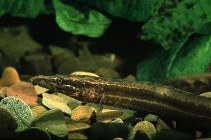
背面の脊椎 (合計) : 18 - 35; 背鰭 (合計) : 64 - 73; 肛門の骨: 2; 臀鰭: 67 - 80; 脊つい: 95 - 96. Diagnosis: Anterior nostril in the form of a short tentacle; snout produced as a fleshy appendage (Ref. 34290). Number of dorsal-fin spines 18-35; anal fin with 2 separate spines (Ref. 34290, 123814). Colour extremely variable, ground colour brown with a variable reticulated and blotched pattern (Ref. 34290). Body shape (shape guide): eel-like.
Mainly riverine species, but also occurs in lakes near river mouths and in vegetated fringes and in swamps (Ref. 80296). Also found in rapids where it hides among rocks (Ref. 85214). Essentially a sedentary fish, nocturnal and usually waiting for its prey to swim or drift within range whereupon fish will dart out of its shelter to seize it (Ref. 89002). Feeds on aquatic insect larvae (Ref. 80296), lithophilic insects (Ref. 12526), fish (Ref. 13624, 27292), shrimps (Ref. 246, 80296), oligochetes and occasionally vegetable matter (Ref. 80296, 89002). Breeds during flood season, in inundated areas (Ref. 80296). Eggs yellow and large, probably spawned among water weeds (Ref. 89002).
Travers, R.A., G. Eynikel and D.F.E. Thys van den Audenaerde, 1986. Mastacembelidae. p. 415-427. In J. Daget, J.-P. Gosse and D.F.E. Thys van den Audenaerde (eds.) Check-list of the freshwater fishes of Africa (CLOFFA). ISNB, Brussels; MRAC, Tervuren; and ORSTOM, Paris. Vol. 2. (Ref. 6060)
IUCNのレッドリストの状況は (Ref. 130435: Version 2025-2 (Global))
系統多様性指数 (参照 82804): PD50 = 0.5000 [Uniqueness, from 0.5 = low to 2.0 = high].
Bayesian length-weight: a=0.00269 (0.00129 - 0.00562), b=2.94 (2.76 - 3.12), in cm total length, based on LWR estimates for this (Sub)family-body shape (Ref. 93245).
栄養段階 (参照 69278): 3.9 ±0.63 se; based on food items.
回復力 (参照 120179): 手段, 1.4年~4.4年の倍増期間の最小個体群 (Preliminary K or Fecundity.).
漁業の脆弱性 (Ref. 59153): Moderate vulnerability (39 of 100). 🛈