>
Carangiformes (Jacks) >
Carangidae (Jacks and pompanos) > Naucratinae
Etymology: Seriola: Latin word diminutive with the meaning of a large earthenware pot (Ref. 45335).
Eponymy: François Victor Masséna Prince d’Essling, 2nd Duc de Rivoli (1799–1863), was the son of one of Napoleon’s marshals and an amateur ornithologist. [...] (Ref. 128868), visit book page.
More on author: Valenciennes.
Environnement : milieu / zone climatique / profondeur / gamme de distribution
Écologie
marin récifal; profondeur 5 - 245 m (Ref. 90102), usually 30 - 35 m (Ref. 40849). Subtropical; 43°N - 38°S, 180°W - 180°E
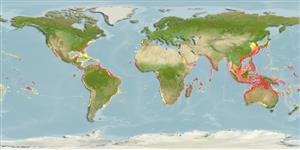
Circumglobal. Indo-West Pacific: Kenya south to South Africa (Ref. 3287) and east to Mariana and Wake islands in Micronesia, north to the Ryukyu Islands, south to New Caledonia and the Kermadec Islands (Ref. 8879). Absent from the Red Sea and French Polynesia. Likely at Seychelles (Ref. 1623). Eastern Pacific: USA to Peru, including Galapagos Islands (Ref. 2850). Western Atlantic: Cape Cod, USA to northern Argentina (Ref. 9626). Distribution in the eastern Atlantic is not well established. Recently recorded from Lampedusa Island in the Mediterranean (Ref. 47878).
Taille / Poids / Âge
Maturité: Lm ? range ? - ? cm
Max length : 160 cm FL mâle / non sexé; (Ref. 40637); common length : 90.0 cm TL mâle / non sexé; (Ref. 5450); poids max. publié: 59.9 kg (Ref. 40637)
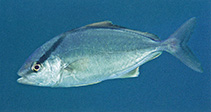
Épines dorsales (Total) : 8; Rayons mous dorsaux (Total) : 27 - 33; Épines anales: 3; Rayons mous anaux: 18 - 22; Vertèbres: 24. This species is distinguished by the following characters: upper jaw posterior very broad, extends to level of middle of pupil; gill rakers (excluding rudiments) decreasing slightly in number with growth, 6-9 + 18-20 = 24 -29 in 2-7 cm FL individuals, but 22-26 in fish larger than 20 cm FL; length of dorsal-fin lobe about 1.3 to 1.6 times longer than pectoral fins and 18 to 22% of fork length; caudal peduncle with dorsal and ventral grooves present; first pterygiophore of anal fin straight in specimens larger than about 10 cm fork length. Colour: dorsal brown or silvery blue-green to olivaceous, ventral paler or silvery with brassy or lavender reflections, with yellow midlateral stripe usually present, and an oblique, dark yellowish brown band from nape through eye to edge of upper lip, the nuchal bar often persistent in adults (may be absent); juveniles (2-18 cm fork length) with dark nuchal bar and 6 dark body bars, each with a light narrow irregular area through their centre vertically, that do not extend into the membranes of the second dorsal and anal fins, and a seventh bar at the end of caudal peduncle; fins dark or yellowish grey except pelvic fins, white ventrally (Ref. 9894, 90102).
Body shape (shape guide): short and / or deep; Cross section: compressed.
Adults are benthopelagic in outer reef slopes and offshore banks to 160 m or more. They form small groups (Ref. 9283, 26235, 58302). Young often seen around floating objects (Ref. 4887, 48635). They feed mainly on fishes, but also on invertebrates. Eggs are pelagic (Ref. 4233). Marketed fresh and salted or dried (Ref. 9283). May cause ciguatera poisoning, particularly in coral reef areas (Ref. 5217). Uncommon on East Indian reefs but occasionally found in cool upwelling areas of Lesser Sunda Islands of Indonesia (Ref. 90102).
Cycle de vie et comportement reproducteur
Maturité | Reproduction | Frai | Œufs | Fécondité | Larves
Myers, R.F., 1991. Micronesian reef fishes. Second Ed. Coral Graphics, Barrigada, Guam. 298 p. (Ref. 1602)
Statut dans la liste rouge de l'IUCN (Ref. 130435: Version 2025-2 (Global))
Menace pour l'homme
Reports of ciguatera poisoning (Ref. 5217)
Utilisations par l'homme
Pêcheries: commercial; pêche sportive: oui
Outils
Articles particuliers
Télécharger en XML
Sources Internet
Estimations basées sur des modèles
Température préférée (Réf.
123201): 22.1 - 28.6, mean 27.3 °C (based on 201 cells).
Indice de diversité phylogénétique (Réf.
82804): PD
50 = 0.5020 [Uniqueness, from 0.5 = low to 2.0 = high].
Bayesian length-weight: a=0.01862 (0.01118 - 0.03101), b=2.92 (2.77 - 3.07), in cm total length, based on LWR estimates for this species & (Sub)family-body (Ref.
93245).
Niveau trophique (Réf.
69278): 4.5 ±0.7 se; based on diet studies.
Résilience (Réf.
120179): Faible, temps minimum de doublement de population : 4,5 à 14 années (Preliminary K or Fecundity.).
Vulnérabilité de la pêche (Ref.
59153): Very high vulnerability (90 of 100).
🛈
Nutriments (Ref.
124155): Calcium = 14.1 [5.5, 25.1] mg/100g; Iron = 0.56 [0.28, 1.19] mg/100g; Protein = 19.2 [16.2, 22.1] %; Omega3 = 0.17 [0.09, 0.35] g/100g; Selenium = 28.9 [11.7, 63.4] μg/100g; VitaminA = 59.8 [6.7, 525.8] μg/100g; Zinc = 0.353 [0.223, 0.542] mg/100g (wet weight);