Taxonomic Remarks
The species Mastacembelus goro Boulenger, 1902 is considered valid in Eschmeyer (CofF ver. May 2011: Ref. 86870). It is treated here a synonym of Mastacembelus niger Sauvage, 1879 following the recent work of Vreven (2008: 81678).
Ambiente: milieu / zona climatica / distribuzione batimetrica / gamma di distribuzione
Ecologia
; acqua dolce demersale. Tropical
Africa: Mbonge River basin in Cameroon to the Shiloango River basin in Democratic Republic of the Congo (Ref. 81678). Also present in the Congo River basin (Ref. 81678) from the Kinsuka rapids and Pool Malebo (Ref. 41585) up to the Wagenia Falls (Ref. 106245). Reports of Mastacembelus flavomarginatus from the rivers Konkouré (Ref. 3009) and Sassandra (Ref. 3057) are misidentifications of respectively Mastacembelus kakrimensis (Ref. 55095) and Mastacembelus praensis (Ref. 57415).
Dimensione / Peso / Età
Maturità: Lm ? range ? - ? cm
Max length : 37.5 cm SL maschio/sesso non determinato; (Ref. 81678)
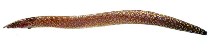
Vertebre: 89 - 98. Diagnosis: distance from tip of snout to last externally visible dorsal spine 49.5-67.6% SL (mean 60.5%), decreasing with size; postanal length 38.5-53.4% SL (mean 44.7%), increasing with size; distance from tip of snout to last externally visible anal spine 49.2-67.0% SL (mean 59.1%), decreasing with size; distance from posterior edge of pectoral fin to anterior origin of first dorsal spine, 19.4-86.4% HL (mean 52.4%); gill opening small, its distance to dorsal pectoral fin base relatively long, 8.3-14.9% HL (mean 11.5%); 24+1 up to 33+1 (median 30+1) dorsal spines; origin of soft dorsal fin slightly anterior or posterior to origin of soft anal fin (Ref. 81678).
Body shape (shape guide): eel-like.
Occurs in shallow waters (Ref. 6060). Maximum reported total length 387 mm (Ref. 81678).
Ciclo vitale e comportamento di accoppiamento
Maturità | Riproduzione | Deposizione | Uova | Fecondità | Larve
Travers, R.A., G. Eynikel and D.F.E. Thys van den Audenaerde, 1986. Mastacembelidae. p. 415-427. In J. Daget, J.-P. Gosse and D.F.E. Thys van den Audenaerde (eds.) Check-list of the freshwater fishes of Africa (CLOFFA). ISNB, Brussels; MRAC, Tervuren; and ORSTOM, Paris. Vol. 2. (Ref. 6060)
Stato della Lista Rossa IUCN (Ref. 130435: Version 2025-2 (Global))
Minaccia per l'uomo
Harmless
Usi umani
Strumenti
Rapporti speciali
Scarica XML
Fonti Internet
Stime basate su modelli
Indice di diversità filogenetica (Fonte Biblio.
82804): PD
50 = 0.5000 [Uniqueness, from 0.5 = low to 2.0 = high].
Bayesian length-weight: a=0.00269 (0.00129 - 0.00562), b=2.94 (2.76 - 3.12), in cm total length, based on LWR estimates for this (Sub)family-body shape (Ref.
93245).
Livello trofico (Fonte Biblio.
69278): 3.9 ±0.6 se; based on size and trophs of closest relatives
Resilienza (Fonte Biblio.
120179): Medio, tempo minimo di raddoppiamento della popolazione 1.4 - 4.4 anni (Preliminary K or Fecundity.).
Vulnerabilità della pesca (Ref.
59153): Moderate vulnerability (36 of 100).
🛈
Nutrienti (Ref.
124155): Calcium = 320 [172, 823] mg/100g; Iron = 2.77 [1.21, 5.86] mg/100g; Protein = 17.6 [15.8, 19.3] %; Omega3 = 0.272 [0.114, 0.636] g/100g; Selenium = 26.1 [7.4, 97.6] μg/100g; VitaminA = 45.3 [15.9, 125.1] μg/100g; Zinc = 1.56 [0.83, 3.10] mg/100g (wet weight);