>
Carangiformes (Jacks) >
Carangidae (Jacks and pompanos) > Trachinotinae
Etymology: Trachinotus: Greek, trachys, -eia, -ys = rough + Greek,noton = back (Ref. 45335).
Eponymy: Dr George Brown Goode (1851–1896) was an American ichthyologist and museum administrator at the Smithsonian. [...] (Ref. 128868), visit book page.
More on authors: Jordan & Evermann.
Entorno: milieu / zona climática / rango de profundidad / gama de distribución
Ecología
marino asociado a arrecife; rango de profundidad 0 - 12 m (Ref. 9710). Subtropical; 43°N - 37°S
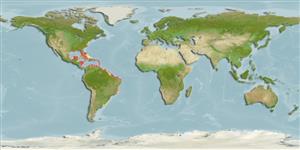
Western Atlantic: Massachusetts (USA), Bermuda, and the Gulf of Mexico to Argentina.
Tamaño / Peso / Edad
Madurez: Lm ? range ? - ? cm
Max length : 50.0 cm TL macho / no sexado; (Ref. 7251); common length : 35.0 cm TL macho / no sexado; (Ref. 5217); peso máximo publicado: 560.00 g (Ref. 40637)
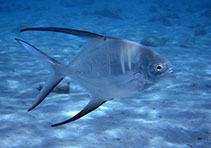
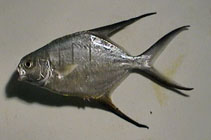
Espinas dorsales (total) : 7 - 8; Radios blandos dorsales (total) : 19 - 20; Espinas anales: 2 - 3; Radios blandos anales: 16 - 18. Dorsal and anal fins have very long, dark anterior lobes (Ref. 26938). Bluish silver on back, shading to silver on sides, with four narrow dark bars on upper of body (Ref. 13442).
Body shape (shape guide): short and / or deep.
Adults form schools in clear coastal areas, usually near coral formations (Ref. 5217). Juveniles common in clean sandy beaches (Ref. 5217). Adults feed on crustaceans, polychaete worms, insect pupae, mollusks and fishes (Ref. 9626). Between 1995 and 2000, at least 2 specimens were traded as aquarium fish at Fortaleza, Ceará (Ref. 49392).
Ciclo vital y comportamiento de apareamiento
Madurez | Reproducción | Puesta | Huevos | Fecundidad | Larva
Robins, C.R. and G.C. Ray, 1986. A field guide to Atlantic coast fishes of North America. Houghton Mifflin Company, Boston, U.S.A. 354 p. (Ref. 7251)
Situación en la Lista Roja de la UICN (Ref. 130435: Version 2025-2 (Global))
Amenaza para el ser humano
Reports of ciguatera poisoning (Ref. 30911)
Usos humanos
Pesquerías: escaso valor comercial; Acuicultura: comercial; pesca deportiva: si
Herramientas
Informes especiales
Descargar XML
Fuentes de Internet
Estimaciones basadas en modelos
Temperatura preferida (Referencia
123201): 23.2 - 28.1, mean 27.3 °C (based on 851 cells).
Índice de diversidad filogenética (Referencia
82804): PD
50 = 0.5000 [Uniqueness, from 0.5 = low to 2.0 = high].
Bayesian length-weight: a=0.01698 (0.00966 - 0.02985), b=2.87 (2.72 - 3.02), in cm total length, based on LWR estimates for this species & Genus-body shape (Ref.
93245).
Nivel trófico (Referencia
69278): 4.3 ±0.4 se; based on diet studies.
Resiliencia (Referencia
120179): Medio, población duplicada en un tiempo mínimo de 1.4-4.4 años (Assuming tm=2-4).
Vulnerabilidad pesquera (Ref.
59153): Moderate vulnerability (40 of 100).
🛈
Nutrientes (Ref.
124155): Calcium = 39.6 [14.6, 74.0] mg/100g; Iron = 0.785 [0.387, 1.762] mg/100g; Protein = 20.1 [18.1, 22.2] %; Omega3 = 0.158 [0.081, 0.315] g/100g; Selenium = 12 [5, 27] μg/100g; VitaminA = 40.7 [10.2, 151.3] μg/100g; Zinc = 0.509 [0.300, 0.825] mg/100g (wet weight);