>
Salmoniformes (Salmons) >
Salmonidae (Salmonids) > Coregoninae
Etymology: Coregonus: Greek, kore = pupils of the eye + Greek, gonia = angle (Ref. 45335).
Eponymy: Edward William Nelson (1855–1934) was an outstanding American naturalist. [...] (Ref. 128868), visit book page.
More on author: Bean.
Entorno: milieu / zona climática / rango de profundidad / gama de distribución
Ecología
; agua dulce bentopelágico; potamodromo (Ref. 27547). Boreal; 68°N - 59°N
North America: Probably restricted to northern Northwest Territories, Yukon Territory in Canada and Alaska in Yukon River, Paxson Lake, Copper River system, Anderson River and Mackenzie River delta. Hybridizes with Stenodus leucichthys, probably a result of simultaneous broadcasting of reproductive products in the same area; occasionally hybridizes with Coregonus sardinella (Ref. 27547). Belongs to the Coregonus clupeaformis complex (Ref. 27547).
Tamaño / Peso / Edad
Madurez: Lm ? range ? - ? cm
Max length : 56.0 cm TL macho / no sexado; (Ref. 5723)
Descripción breve
Claves de identificación | Morfología | Morfometría
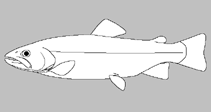
Espinas dorsales (total) : 0; Radios blandos dorsales (total) : 11 - 13; Espinas anales: 0; Radios blandos anales: 10 - 14; Vértebra: 60 - 63. Distinguished by the gill rakers that are longer than 20% of the interorbital width, a total of 22 to 27 gill rakers on the first arch (with modal counts of 24 or 25), and a pronounced hump behind the head in adults (Ref. 27547). Adipose fin well developed, often larger in males; axillary process present in pelvic fins (Ref. 27547). Dark brown to midnight blue above fading to silver on sides and wide beneath; no parr marks in young (Ref. 27547).
Body shape (shape guide): fusiform / normal.
Occurs in small to large rivers (Ref. 5723). Rarely enters lakes (Ref. 5723). Makes fairly extensive upstream and downstream movements related to spawning runs (Ref. 27547). Feeds mainly on immature insects (Ref. 27547). Usually does not feed during the latter part of the spawning run (Ref. 27547). Excellent food fish but usually not eaten (Ref. 27547).
The spawning run involves an upward migration beginnning as early as late June. The spawning act occurs at night or during the day. A female begins to swim vertically toward the surface, belly upstream. A male (sometimes 2 or 3) joins her and eggs and milt are released as fish approach the surface. The fish break the surface, fall away from each other and return to the bottom. After spawning most move downstream. The young of the year move downstream during their first year and do not return until they are sexually mature. Generally, the same spawning grounds are utilized yearly (Ref. 27547).
Page, L.M. and B.M. Burr, 1991. A field guide to freshwater fishes of North America north of Mexico. Houghton Mifflin Company, Boston. 432 p. (Ref. 5723)
Situación en la Lista Roja de la UICN (Ref. 130435: Version 2025-2 (Global))
Amenaza para el ser humano
Harmless
Usos humanos
Pesquerías: pesquerías de subsistencia; pesca deportiva: si
Herramientas
Informes especiales
Descargar XML
Fuentes de Internet
Estimaciones basadas en modelos
Índice de diversidad filogenética (Referencia
82804): PD
50 = 0.5000 [Uniqueness, from 0.5 = low to 2.0 = high].
Bayesian length-weight: a=0.00537 (0.00266 - 0.01086), b=3.22 (3.06 - 3.38), in cm total length, based on LWR estimates for this Genus-body shape (Ref.
93245).
Nivel trófico (Referencia
69278): 3.5 ±0.43 se; based on food items.
Resiliencia (Referencia
120179): Medio, población duplicada en un tiempo mínimo de 1.4-4.4 años (tm=3-5).
Vulnerabilidad pesquera (Ref.
59153): Moderate vulnerability (42 of 100).
🛈