Elasmobranchii (hajar och rockor) (sharks and rays) >
Myliobatiformes (Stingrays) >
Myliobatidae (Eagle and manta rays)
Etymology: Aetomylaeus: Greek, aetos = eagle + Greek, mylio = mill, grinder (Ref. 45335).
Eponymy: Johan Nieuhoff (1618–1672) was a Dutch traveller who wrote about his journeys to India, China and Brazil. [...] (Ref. 128868), visit book page.
More on authors: Bloch & Schneider.
Miljö: miljö / Klimatzon / djupintervall / distributionsområde
Ekologi
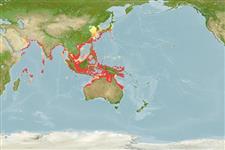
marina; brackvatten bottenlevande; amfidrom (Ref. 51243); djupintervall 1 - 100 m (Ref. 6871). Tropical; 41°N - 24°S, 51°E - 154°E
Indo-West Pacific: Persian Gulf to the Philippines, north to Korea and southern Japan, south to northern Australia. Possibly in the Red Sea and eastern and southern Africa.
e Indo-West Pacific from the Persian/Arabian Gulf westwards to Indonesia, and north to Taiwan, China and southern Japan.
Längd vid första mognad / Storlek / Vikt / Ålder
Könsmognad: Lm 40.5, range 39 - 42 cm
Max length : 65.0 cm WD hane/ej könsbestämd; (Ref. 47613)
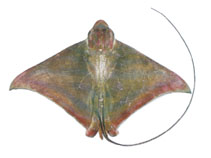
This small species of Aetomylaeus (reaching to about 72.0 cm DW) is distinguished by the following set of characters: dorsal surface is greyish brown with a series of usually 8 (sometimes 7) transverse pale bluish bands (which are sometimes faint), no dark spots or blotches; ventral surface is whitish, pectoral fins is dusky distally; tail is rather long (1.4-1.8 times DW); without stinging spine; short and narrow head; fleshy rostral lobe, relatively broad, short, with a rounded apex; teeth usually in 7 rows in each jaw, with a broad median row flanked by 3 smaller rows on each side; dorsal-fin origin level with pelvic-fin insertions; radials of pectoral-fin 84-88 (excluding concealed propterygial radials anterior of eyes); total vertebral centra (including synarcual) 83-93; males have 16-19 pelvic radials (excluding clasper); females have 20 or 21 pelvic radials (Ref. 103981).
Body shape (shape guide): other; Cross section: flattened.
Maximum depth reported taken from Ref. 9773.
Livscykel och parningsbeteende
Könsmognad | Reproduktion | Lek | Ägg | Fekunditet | Larver
Exhibit ovoviparity (aplacental viviparity), with embryos feeding initially on yolk, then receiving additional nourishment from the mother by indirect absorption of uterine fluid enriched with mucus, fat or protein through specialised structures (Ref. 50449). Gives birth to ~4 pups; born at ~17 cm WD (Ref.58048).
Last, P.R. and J.D. Stevens, 1994. Sharks and rays of Australia. CSIRO, Australia. 513 p. (Ref. 6871)
Status på IUCN:s rödlista (Ref. 130435: Version 2025-2 (Global))
Hot mot människor
Harmless
Mänskliga användningsområden
Fiskeri: mindre kommeriell
Verktyg
Särskilda rapporter
Ladda ner XML
Internet-källor
Uppskattningar baserade på modeller
Önskad temperatur (Ref.
123201): 23.8 - 28.3, mean 27.3 °C (based on 618 cells).
Index för fylogenetisk mångfald (Ref.
82804): PD
50 = 0.5039 [Uniqueness, from 0.5 = low to 2.0 = high].
Bayesian length-weight: a=0.00389 (0.00124 - 0.01219), b=3.08 (2.83 - 3.33), in cm total length, based on LWR estimates for this (Sub)family-body shape (Ref.
93245).
Trofisk nivå (Ref.
69278): 3.9 ±0.48 se; based on food items.
Resiliens (Ref.
120179): Mycket låg, lägsta populationsfördubblingstid mer än 14 år (Fec=4).
Sårbarhet i fisket (Ref.
59153): Very high vulnerability (83 of 100).
🛈
Näringsämnen (Ref.
124155): Calcium = 46.2 [10.7, 204.4] mg/100g; Iron = 0.822 [0.206, 2.137] mg/100g; Protein = 21.5 [16.4, 26.6] %; Omega3 = 0.14 [0.04, 0.52] g/100g; Selenium = 36.8 [9.5, 98.7] μg/100g; VitaminA = 16.9 [7.5, 36.5] μg/100g; Zinc = 1.07 [0.53, 1.96] mg/100g (wet weight);