>
Lophiiformes (Anglerfishes) >
Diceratiidae (Double anglers (Ref. 07463) or Doublespine Seadevils (Ref. 86949))
Etymology: Bufoceratias: Latin, bufo or bufonis = toad + Greek, keras or keratos = horn, horned (referring to the hornlike lure projecting from the head) (Ref. 86949).
Eponymy: Anton Wedl (1864–1929) was an industrialist, wholesale merchant and philanthropist in New York who was born in Vienna and maintained links there being on the board of directors of the Austrian Commercial & Industrial Bank (1912). [...] (Ref. 128868), visit book page.
Umwelt: Milieu / Klimazone / Tiefenbereich / Verbreitungsgebiet
Ökologie
seewasser bathypelagisch; tiefenbereich 300 - 1750 m (Ref. 40877), usually 300 - 1500 m (Ref. 6613). Deep-water
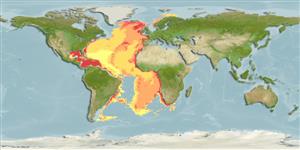
Western Atlantic: Gulf of Mexico and the Caribbean Sea to coastal waters off Suriname. Eastern Atlantic: off Portugal to coastal waters of Namibia, as far south as about 24°S. The single specimen recorded from the Okinawa Trough, East China Sea (Ref. 51075) is a misidentification of Bufoceratias thele.
Größe / Gewicht / Alter
Geschlechtsreife: Lm ? range ? - ? cm
Max length : 25.0 cm TL (female)
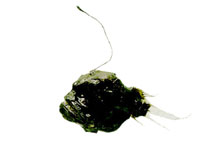
Rückenflossenstacheln (insgesamt) : 2; Rückenflossenweichstrahlen (insgesamt) : 5 - 6; Afterflossenstacheln: 0; Afterflossenweichstrahlen: 4. Metamorphosed females of Bufoceratias wedli differ from those of Bufoceratias shaoi in having a much smaller esca and a longer illicium (83-225% standard length versus 26-40% standard length), and from those of Bufoceratias thele in having distinct, anterior, posterior, and lateral escal appendages (Ref. 51070).
Body shape (shape guide): short and / or deep.
Mesopelagic and bathypelagic near or on continental shelf (Ref. 6939). Males and larvae unknown (Ref. 51070), probably dwarfed, non-parasitic (Ref. 6939). Minimum depth from Ref. 6613.
Lebenszyklus und Paarungsverhalten
Geschlechtsreife | Fortpflanzung | Ablaichen | Eier | Fruchtbarkeit | Larven
Pietsch, T.W., H.-C. Ho and H.-M. Chen, 2004. Revision of the deep-sea anglerfish genus Bufoceratias Whitley (Lophiiformes: Ceratioidei: Diceratiidae), with description of a new species from the Indo-West Pacific Ocean. Copeia 2004(1):98-107. (Ref. 51070)
IUCN Rote Liste Status (Ref. 130435: Version 2025-2 (Global))
Bedrohung für Menschen
Harmless
Nutzung durch Menschen
Fischereien: nicht kommerziell
Tools
Zusatzinformationen
Download XML
Internet Quellen
Schätzungen auf der Grundlage von Modellen
Bevorzugte Temperatur (Ref.
123201): 2.8 - 11.6, mean 5.6 °C (based on 1239 cells).
Phylogenetischer Diversitätsindex (Ref.
82804): PD
50 = 0.5703 [Uniqueness, from 0.5 = low to 2.0 = high].
Bayesian length-weight: a=0.01995 (0.00906 - 0.04395), b=3.01 (2.83 - 3.19), in cm total length, based on all LWR estimates for this body shape (Ref.
93245).
Trophische Ebene (Ref.
69278): 4.0 ±0.5 se; based on size and trophs of closest relatives
Anfälligkeit der Fischerei (Ref.
59153): Low vulnerability (15 of 100).
🛈