>
Scombriformes (Mackerels) >
Chiasmodontidae (Snaketooth fishes)
Etymology: Chiasmodon: Name from the Greek 'chiasmos' which means diagonally arranged, and 'odous' for tooth or teeth.
Environnement : milieu / zone climatique / profondeur / gamme de distribution
Écologie
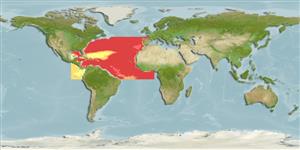
marin pelagic-oceanic; profondeur 700 - 2745 m (Ref. 58426), usually 750 - ? m (Ref. 6649). Deep-water; 46°N - 5°S, 95°W - 5°E (Ref. 82429)
North Atlantic: tropical and temperate; including Gulf of Mexico, from 95°W to 5°E, 46°N to 5°S (Ref. 82429). Southwestern Atlantic: Argentina (Ref. 44852).
Taille / Poids / Âge
Maturité: Lm ? range ? - ? cm
Max length : 25.0 cm SL mâle / non sexé; (Ref. 6944)
Description synthétique
Clés d'identification | Morphologie | Morphométrie
Vertèbres: 43 - 44. This species is distinguished from its congeners by a set of characteristics: from C. braueri by the teeth on second ceratobranchial absent (vs. present) and supraorbital canal pores 7 (vs. 8); from C. harteli by total vertebrae 43-45 (vs. 47-48), supraorbital canal pores 7 (vs. six); from C. microcephalus by teeth on basibranchials well developed, 3-18, always present on second basibranchial and often on third basibranchial and second hypobranchial (vs. usually no teeth on basibranchials, rarely 1-3, small, restricted to second basibranchial); from C. pluriradiatus and C. asper, by pectoral-fin rays 13-14 (vs. 15-16), tiny dermal spinules on body of specimens larger than 45.0 mm absent (vs. with spinules), fang in premaxillary head 1 (vs. 2), and supraorbital pores 7 (vs. 8 and 9, respectively) and from C. pluriradiatus by lateral-line pores 86-93 (vs. 91-94); from C. subniger, by teeth on second basibranchial present (vs. none), infraorbital pores 14 (vs. 12-13, modally 13), snout elongate and pointed, 22.2-26.6% HL (vs. snout short and blunt, 21.4-23.9% HL), upper jaw 72.2-80.0% HL (vs. 63.9-72.7% HL), and lower jaw 80.0-86.7% HL (vs. 69.0-76.7% HL) (Ref. 82429).
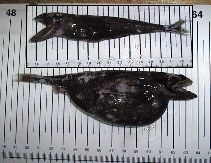
Body shape (shape guide): elongated.
Mesopelagic to bathypelagic species (Ref. 6944, 28429). Specimens larger than 4.5 cm are more frequently collected between 730 and 1900 m with shallowest record being 150 m, the deepest 3900 m (mean 1390 m). Juveniles are found in shallower water, from 0 to 1,050 m (mean 542 m), with the smallest specimens (>10.0 mm) collected nearest to the surface (Ref. 82429). Feed on whole fish, often of individuals longer than themselves (Ref. 9686). Most specimens were taken at depths greater than 750 m (Ref. 6649).
Cycle de vie et comportement reproducteur
Maturité | Reproduction | Frai | Œufs | Fécondité | Larves
Melo, M.R.S., 2009. Revision of the genus Chiasmodon (Acanthomorpha: Chiasmodontidae), with description of two new species. Copeia 2009(3):583-608. (Ref. 82429)
Statut dans la liste rouge de l'IUCN (Ref. 130435: Version 2025-2 (Global))
Menace pour l'homme
Harmless
Utilisations par l'homme
Pêcheries: sans intérêt
Outils
Articles particuliers
Télécharger en XML
Sources Internet
Estimations basées sur des modèles
Température préférée (Réf.
123201): 4.2 - 8.7, mean 4.9 °C (based on 355 cells).
Indice de diversité phylogénétique (Réf.
82804): PD
50 = 0.5078 [Uniqueness, from 0.5 = low to 2.0 = high].
Bayesian length-weight: a=0.00389 (0.00180 - 0.00842), b=3.12 (2.94 - 3.30), in cm total length, based on all LWR estimates for this body shape (Ref.
93245).
Niveau trophique (Réf.
69278): 4.2 ±0.73 se; based on food items.
Vulnérabilité de la pêche (Ref.
59153): Low vulnerability (21 of 100).
🛈
Nutriments (Ref.
124155): Calcium = 16.1 [5.5, 59.7] mg/100g; Iron = 0.607 [0.217, 1.659] mg/100g; Protein = 2.57 [0.00, 6.41] %; Omega3 = 0.382 [0.156, 0.978] g/100g; Selenium = 14.6 [4.3, 51.1] μg/100g; VitaminA = 15.3 [3.4, 71.6] μg/100g; Zinc = 0.383 [0.190, 0.761] mg/100g (wet weight);