>
Eupercaria/misc (Various families in series Eupercaria) >
Sciaenidae (Drums or croakers)
Etymology: Pseudotolithus: Greek, pseudes = false + greek, otos = ear + Greek, lithos = stone (Ref. 45335).
More on author: Bleeker.
สิ่งแวดล้อม : สิ่งแวดล้อม / เขตภูมิอากาศ / ระดับความลึก / ระยะการกระจายสินค้า
นิเวศวิทยา
เกี่ยวกับทะเล,น้ำเค็ม; น้ำจืด; กร่อย สัตว์น้ำหน้าดิน; ระดับความลึก 0 - 160 m (Ref. 3593). Tropical; 12°N - 17°S
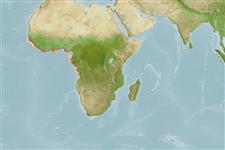
Eastern Atlantic: Guinea-Bissau (Ref. 26999) to southern Angola (Ref. 3593, 81656). Possibly also occurring more to the north (Ref. 81656).
ขนาด / น้ำหนัก / อายุ
วัยเจริญพันธุ์: Lm ? range ? - ? cm
Max length : 60.0 cm TL เพศผู้/กระเทย; (Ref. 3593); common length : 35.0 cm TL เพศผู้/กระเทย; (Ref. 3593)
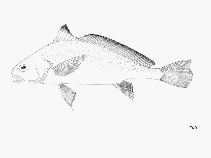
เงี่ยงครีบหลัง (รวม) : 10; ก้านครีบอ่อนที่หาง (รวม) : 35 - 39; เงี่ยงครีบก้น: 2; ก้านครีบอ่อนที่ก้น: 7. Diagnosis: moderately sized species with an elongate and laterally compressed body; dorsal with 9 (10?) spines in 1st part, second part with 1 spine and 35-39 soft fin rays; second anal spine clearly shorter than first anal fin soft ray, i.e. about half its length, and robust; pectoral fins long, 23.3-27.3% SL; caudal fin S-shaped; mouth inferior almost horizontal; maxilla extending to posterior half of eye; 7-9/1/4-7 (total 13-18) gill rakers on 1st gill arch; lower part of 1st gill arch with 2-6 reduced additional gill rakers, upper part with 0-2 reduced additional ones; gill rakers moderately long and fine, but shorter than the gill filament at angle between lower and upper part of gill arch; preopercular edge feebly denticulated but never with spines; eyes rather small, 4.6-5.4 times in HL, but this character is difficult to use for identification because of allometry (Ref. 81656).
Coloration: generally very dark, but occasionally pale silver often with faint dark brown oblique lines on sides; ventral side of head and belly yellowish; all fins greyish to very dark brown, black (Ref. 81656).
Body shape (shape guide): elongated; Cross section: compressed.
Occurs in coastal waters from the shore to about 70 m over mud bottom, but moves to deeper water. Also found in estuaries and coastal lagoons (Ref. 3593, 81656). Mainly feeds on benthic invertebrates (Ref. 81656).
วงจรชีวิตและพฤติกรรมการผสมพันธุ์
วัยเจริญพันธุ์ | การสืบพันธุ์ | การวางไข่ | เซลสืบพันธ์ของเพศเมีย(ไข่) | ความดกของไข่ | ตัวอ่อน
Chao, L.N. and E. Trewavas, 1990. Sciaenidae. p. 813-826. In J.C. Quero, J.C. Hureau, C. Karrer, A. Post and L. Saldanha (eds.) Check-list of the fishes the eastern tropical Atlantic (CLOFETA). JNICT, Lisbon; SEI, Paris; and UNESCO, Paris. Vol. 2. (Ref. 3593)
สถานะบัญชีแดงของ IUCN (Ref. 130435: Version 2025-2 (Global))
ภัยคุกคามต่อมนุษย์
Harmless
การใช้ของมนุษย์
การประมง: การค้า
เครื่องมือ
รายงานพิเศษ
ดาวน์โหลด XML
แหล่งที่มาจากอินเตอร์เน็ต
การประมาณค่าตามแบบจำลอง
อุณหภูมิที่ต้องการ (อ้างอิง
123201): 19.2 - 27.9, mean 26 °C (based on 102 cells).
ดัชนีความหลากหลายทางวิวัฒนาการ (อ้างอิง
82804): PD
50 = 0.5156 [Uniqueness, from 0.5 = low to 2.0 = high].
Bayesian length-weight: a=0.00575 (0.00277 - 0.01195), b=3.13 (2.95 - 3.31), in cm total length, based on LWR estimates for this (Sub)family-body shape (Ref.
93245).
ระดับชั้นอาหาร (อ้างอิง
69278): 3.6 ±0.6 se; based on size and trophs of closest relatives
ความสามารถในการกลับคืนสู่ปกติ (อ้างอิง
120179): ขนาดกลาง, เวลาต่ำสุดที่จะทำให้ประชากรเพิ่มขึ้นเป็น 2 เท่าใช้เวลา 1.4 - 4.4 ปี (Preliminary K or Fecundity.).
ความเสี่ยงต่อการตกปลา (Ref.
59153): Moderate vulnerability (44 of 100).
🛈
สารอาหาร (Ref.
124155): Calcium = 114 [62, 210] mg/100g; Iron = 0.872 [0.469, 1.499] mg/100g; Protein = 18.7 [17.5, 19.8] %; Omega3 = 0.156 [0.078, 0.287] g/100g; Selenium = 75.1 [39.5, 144.8] μg/100g; VitaminA = 15.5 [6.1, 43.4] μg/100g; Zinc = 1.15 [0.82, 1.64] mg/100g (wet weight);