>
Tetraodontiformes (Puffers and filefishes) >
Diodontidae (Porcupinefishes (burrfishes))
Etymology: Chilomycterus: Greek, cheilos = lip + Greek, mykter, -eros = nose (Ref. 45335).
More on author: Linnaeus.
Entorno: milieu / zona climática / rango de profundidad / gama de distribución
Ecología
marino asociado a arrecife; rango de profundidad 20 - 100 m (Ref. 9680). Subtropical; - 24°S, 98°W - 34°W
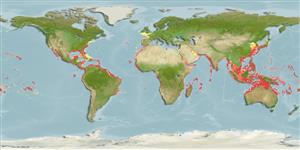
Circumglobal: Gulf of Mexico, Atlantic, Indian and Pacific oceans.
Tamaño / Peso / Edad
Madurez: Lm ? range ? - ? cm
Max length : 69.7 cm NG macho / no sexado; (Ref. 89467); common length : 30.0 cm TL macho / no sexado; (Ref. 26999)
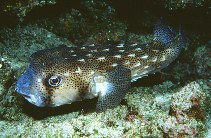
Espinas dorsales (total) : 0; Radios blandos dorsales (total) : 12 - 14; Espinas anales: 0; Radios blandos anales: 11 - 14. Adults grey to brown with a black gular band and small black spots on upper surfaces and fins; pelagic juveniles blue with dark spots above, the spots descending to belly (Ref. 4423).
Body shape (shape guide): short and / or deep.
Adults found in reefs and over soft bottoms to depths of 100 m, but may occur deeper in the tropics (Ref. 30573). Often found washed up on beaches. Known to brace themselves against the substrate to sleep at night (Ref. 4930). Appear to be active during the day. Juveniles often with floating weeds (Ref. 48637). Solitary. Juveniles pelagic in oceanic surface waters (Ref. 30573). Feed on hard-shelled invertebrates. Not usually marketed.
Ciclo vital y comportamiento de apareamiento
Madurez | Reproducción | Puesta | Huevos | Fecundidad | Larva
Leis, J.M., 2001. Diodontidae. Porcupine fishes (burrfishes). p. 3958-3965. In K.E. Carpenter and V. Niem (eds.) FAO species identification guide for fishery purposes. The living marine resources of the Western Central Pacific. Vol. 6. Bony fishes part 4 (Labridae to Latimeriidae), estuarine crocodiles. FAO, Rome. (Ref. 9680)
Situación en la Lista Roja de la UICN (Ref. 130435: Version 2025-2 (Global))
Amenaza para el ser humano
Venomous
Usos humanos
Pesquerías: sin interés
Herramientas
Informes especiales
Descargar XML
Fuentes de Internet
Estimaciones basadas en modelos
Temperatura preferida (Referencia
123201): 18.4 - 28.3, mean 27 °C (based on 959 cells).
Índice de diversidad filogenética (Referencia
82804): PD
50 = 0.5156 [Uniqueness, from 0.5 = low to 2.0 = high].
Bayesian length-weight: a=0.04786 (0.01950 - 0.11750), b=2.82 (2.61 - 3.03), in cm total length, based on LWR estimates for this (Sub)family-body shape (Ref.
93245).
Nivel trófico (Referencia
69278): 3.5 ±0.41 se; based on food items.
Resiliencia (Referencia
120179): Alto, población duplicada en un tiempo mínimo inferior a 15 meses (Preliminary K or Fecundity.).
Vulnerabilidad pesquera (Ref.
59153): Low vulnerability (20 of 100).
🛈
Nutrientes (Ref.
124155): Calcium = 18 [7, 59] mg/100g; Iron = 0.558 [0.274, 1.366] mg/100g; Protein = 19.2 [17.0, 21.4] %; Omega3 = 0.166 [0.086, 0.318] g/100g; Selenium = 25.4 [10.8, 56.7] μg/100g; VitaminA = 17.8 [4.5, 80.2] μg/100g; Zinc = 0.572 [0.367, 0.913] mg/100g (wet weight);