>
Syngnathiformes (Pipefishes and seahorses) >
Syngnathidae (Pipefishes and seahorses) > Syngnathinae
Etymology: Halicampus: Greek, als, alis = salt + Greek, kampe = bend (Ref. 45335).
Milieu: milieu / Klimaatzone / Diepte / verspreidingsgebied
Ecologie
marien rifbewoner; diepte 3 - 25 m (Ref. 9710). Tropical
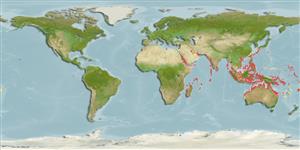
Indo-West Pacific: northern Red Sea (Gulfs of Suez and Aqaba), Indonesia off Sumbawa Islands, Queensland in Australia, Port Moresby in Papua New Guinea, New Britain Islands and Guadalcanal Islands in the Solomon Islands.
Grootte / Gewicht / Leeftijd
Maturiteit: Lm ? range ? - ? cm
Max length : 18.0 cm TL mannelijk / geslacht onbekend; (Ref. 48635)
Korte beschrijving
Determinatiesleutels | Morfologie | Morfometrie
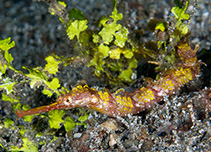
Dorsale stekels (totaal) : 0; Dorsale zachte stralen (totaal) : 18 - 19; Anale zachte stralen: 4. Superior trunk and tail ridges discontinuous; inferior trunk ridge ending at anal ring; lateral trunk ridge continuous with inferior tail ridge; body rings 14 or 15 + 25-25. Colors vary with habitat, colorful on algae-rubble and dull on sand (Ref. 48635).
Body shape (shape guide): eel-like; Cross section: angular.
Adults inhabit reef flats where it is found in seagrass areas, among coral rubble and algae-covered rocks. Juveniles occur with round-leafed seagrasses on sand slopes, usually settling from pelagic state at about 8 cm long. Adults on sand or algae covered reefs to about 25 m depth (Ref. 48635). Ovoviviparous (Ref. 205). The male carries the eggs in a brood pouch which is found under the tail (Ref. 205). Solitary or in pairs (Ref 90102).
Levenscyclus en paargedrag
Maturiteit | Voortplanting | Paaien | Eieren | Fecunditeit | Larven
Male carries the eggs in a brood pouch (Ref. 205).
Dawson, C.E., 1985. Indo-Pacific pipefishes (Red Sea to the Americas). The Gulf Coast Research Laboratory Ocean Springs, Mississippi, USA. (Ref. 5316)
Status op de Rode Lijst van het IUCN (Ref. 130435: Version 2025-2 (Global))
Gevaar voor de mens
Harmless
Gebruik door de mens
Tools
Speciale rapporten
Download XML
Internetbronnen
Schattingen op basis van modellen
Gewenste temperatuur (Ref.
123201): 25.2 - 29.3, mean 28.4 °C (based on 2080 cells).
Fylogenetische diversiteitsindex (Ref.
82804): PD
50 = 0.5002 [Uniqueness, from 0.5 = low to 2.0 = high].
Bayesian length-weight: a=0.00035 (0.00015 - 0.00079), b=3.19 (3.00 - 3.38), in cm total length, based on LWR estimates for this (Sub)family-body shape (Ref.
93245).
Trofisch niveau (Ref.
69278): 3.4 ±0.5 se; based on size and trophs of closest relatives
Weerstandsvermogen (Ref.
120179): Hoog, minimale populatieverdubbelingstijd minder dan 15 maanden (Preliminary K or Fecundity.).
Kwetsbaarheid van de visserij (Ref.
59153): Low vulnerability (10 of 100).
🛈