>
Cypriniformes (Carps) >
Leuciscidae (Minnows) > Pogonichthyinae
Etymology: Notropis: A misnomer given by Rafinesque to shriveled specimens, with the meaning of "back keel"; from Greek, noton = back (Ref. 45335); rupestris: Specific epithet is an adjective meaning to live among rocks, referring to the bedrock and rubble pools which the species lives.
Milieu: milieu / Klimaatzone / Diepte / verspreidingsgebied
Ecologie
; zoet water benthopelagisch. Temperate; 37°N - 36°N
North America: lower Caney Fork system and nearby tributaries of central Cumberland River drainage in Tennessee, USA.
Grootte / Gewicht / Leeftijd
Maturiteit: Lm ? range ? - ? cm
Max length : 7.0 cm TL mannelijk / geslacht onbekend; (Ref. 58354)
Korte beschrijving
Determinatiesleutels | Morfologie | Morfometrie
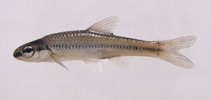
Dorsale zachte stralen (totaal) : 8; Anale zachte stralen: 7 - 9. Distinguished from its congeners by the following combination of characters: black-stripe around snout and along side to caudal-fin base, followed by a small black spot; black stripe along side connects a series of crescents, on at the posterior edge of each lateral-line scale; lateral line usually complete; body slender, fairly compressed with notably arched nape; dorsal-fin origin over to slightly behind pelvic-fin origin; small mouth, nearly terminal; predorsal scales 10-14, usually 11-13; gill rakers 8-11, rarely 7; peritoneum black (Ref. 58354).
Body shape (shape guide): elongated; Cross section: oval.
Adults occur usually near emergent vegetation in bedrock pools of headwaters, creeks and small rivers. These areas are prone to intermittency and harbor relatively few other fishes. This species appear to be extreme in its ability to tolerate stagnant conditions resulting from low water (Ref. 58354). Adults feed on midge larvae, chydorid cladocerans, water mites, copepods and small mayflies (Ref. 10294). Migratory behaviour is undetermined (Ref. 126106).
Levenscyclus en paargedrag
Maturiteit | Voortplanting | Paaien | Eieren | Fecunditeit | Larven
Page, L.M. and E.C. Beckham, 1987. Notropis rupestris, a new cyprinid from the middle Cumberland River system, Tennessee, with comments on variation in Notropis heterolepis. Copeia 1987(3):659-668. (Ref. 58354)
Status op de Rode Lijst van het IUCN (Ref. 130435: Version 2025-2 (Global))
Gevaar voor de mens
Harmless
Gebruik door de mens
Tools
Speciale rapporten
Download XML
Internetbronnen
Schattingen op basis van modellen
Fylogenetische diversiteitsindex (Ref.
82804): PD
50 = 0.5000 [Uniqueness, from 0.5 = low to 2.0 = high].
Bayesian length-weight: a=0.00537 (0.00266 - 0.01086), b=3.10 (2.92 - 3.28), in cm total length, based on LWR estimates for this (Sub)family-body shape (Ref.
93245).
Trofisch niveau (Ref.
69278): 3.0 ±0.4 se; based on size and trophs of closest relatives
Weerstandsvermogen (Ref.
120179): Hoog, minimale populatieverdubbelingstijd minder dan 15 maanden (Preliminary K or Fecundity.).
Kwetsbaarheid van de visserij (Ref.
59153): Low vulnerability (10 of 100).
🛈