>
Centrarchiformes (Basses) >
Percichthyidae (Temperate perches) > Percichthyinae
Eponymy: Allan Riverstone McCulloch (1885–1925) was a noted Australian ichthyologist. [...] Despite appearing to be an eponym, this is actually a toponym referring to the Peel River, New South Wales, where the species was first caught (by Europeans). The river was named after Sir Robert Peel (1788–1850). (Ref. 128868), visit book page.
Entorno: milieu / zona climática / rango de profundidad / gama de distribución
Ecología
; agua dulce demersal; potamodromo (Ref. 51243); rango de profundidad ? - 5 m (Ref. 6390). Temperate; 21°S - 37°S
Oceania: throughout most of the Murray-Darling River system of South Australia, Victoria, New South Wales, and Queensland, except for the upper reaches of the southern tributaries (Ref. 6390). Introduced into many lakes and dams throughout Victoria and New South Wales. Their abundance has been drastically reduced across their natural range and they are now considered rare in many Victorian tributaries (Ref. 27498).
Longitud en la primera madurez / Tamaño / Peso / Edad
Madurez: Lm 55.0, range 48 - 62 cm
Max length : 180 cm SL macho / no sexado; (Ref. 5259); common length : 60.0 cm SL macho / no sexado; (Ref. 5259); peso máximo publicado: 113.5 kg (Ref. 27446); edad máxima reportada: 48 años (Ref. 6987)
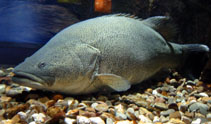
The Murray cod is one of the world's largest freshwater fish (Ref. 6390). They live in a wide range of habitats, from clear, rocky streams to slow flowing, turbid rivers and billabongs (Ref. 27498). They are generally found in waters to 5 m deep, in sheltered areas with cover from rocks, timber or overhanging banks. Adult fish are carnivorous, having a diet of invertebrates, fish, amphibians and occasionally reptiles, birds and aquatic mammals (Ref. 27498). The young feed on zooplankton. Spawning takes place from spring to early summer. Murray cod are territorial, their 'territory' associated with a specific hole, snag (large woody debris) or area of a river or lake (Ref. 27498). Juveniles may undertake migrations (Ref. 6390). Threatened due to over harvesting and habitat loss (Ref. 58490).
Cod form pairs & only one male spawn with each female (Ref. 27498). The spawning site can be in water as shallow as 30 cm (Ref. 27498). The male protect and probably fans the eggs during incubation (Ref. 27498).
Egg masses are laid on the bottom and adhere to the substrate (Ref. 6390).
Allen, G.R., 1989. Freshwater fishes of Australia. T.F.H. Publications, Inc., Neptune City, New Jersey. (Ref. 5259)
Situación en la Lista Roja de la UICN (Ref. 130435: Version 2025-2 (Global))
Amenaza para el ser humano
Harmless
Usos humanos
Pesquerías: comercial; Acuicultura: comercial; pesca deportiva: si
Herramientas
Informes especiales
Descargar XML
Fuentes de Internet
Estimaciones basadas en modelos
Índice de diversidad filogenética (Referencia
82804): PD
50 = 0.5625 [Uniqueness, from 0.5 = low to 2.0 = high].
Bayesian length-weight: a=0.01047 (0.00397 - 0.02763), b=3.01 (2.78 - 3.24), in cm total length, based on LWR estimates for this (Sub)family-body shape (Ref.
93245).
Nivel trófico (Referencia
69278): 4.2 ±0.62 se; based on food items.
Resiliencia (Referencia
120179): Bajo, población duplicada en un tiempo mínimo de 4.5-14 años (tm=3-6; tmax=48).
Vulnerabilidad pesquera (Ref.
59153): High to very high vulnerability (70 of 100).
🛈