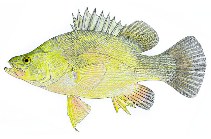
Môi trường: môi trường / vùng khí hậu / Mức độ sâu / phạm vi phân phối
Sinh thái học
; nước ngọt gần đáy; di cư trong nước ngọt (Ref. 51243); mức độ sâu 10 - ? m (Ref. 27439). Temperate; 10°C - 30°C (Ref. 2060); 19°S - 38°S
Oceania: Australia, Murray-Darling system (except in higher tributaries), Dawson-Fitzroy system of southeastern Queensland. Also in Lake Eyre and Bulloo River drainages and floodplain lakes of Western Victoria and New South Wales. Widely introduced to other coastal systems of Queensland and New South Wales.
Chiều dài lúc trưởng thành đầu tiên / Bộ gần gũi / Khối lượng (Trọng lượng) / Tuổi
Chín muồi sinh dục: Lm 45.0, range 40 - 50 cm
Max length : 76.0 cm SL con đực/không giới tính; (Ref. 44894); common length : 45.0 cm SL con đực/không giới tính; (Ref. 5259); Khối lượng cực đại được công bố: 24.0 kg (Ref. 6390); Tuổi cực đại được báo cáo: 20 các năm (Ref. 6390)
Mô tả ngắn gọn
Khóa để định loại | Hình thái học | Sinh trắc học
Golden perch live throughout the river systems, from the clear, fast flowing upper reaches to the turbid, slow flowing lower reaches and associated billabongs and backwaters. They favor deep pools with plenty of cover from fallen timber, rocky ledges or undercut banks (Ref. 27439, 44894). Prefer warm, slow-moving, turbid sections of streams. Also occur in flooded lakes, backwaters and impoundments. Tolerant of temperatures between 4° and 35°C and high salinity levels (up to 35 p.p.t.). Solitary species (Ref. 44894). Their diet is dominated by yabbies (Cherax destructor), and a variety of fish species (Ref. 27439). Juveniles disperse throughout the floodplain to find food and cover (Ref. 27440). They feed on abundant zooplankton on recently inundated floodplains (Ref. 6390, 44894). Adults feed on fishes, mollusks and crayfish (Ref. 44894). Spawn from early spring to late autumn. Golden perch is Australia's most migratory freshwater fish species (Ref. 6390). Spawn in flooded backwaters near the surface at night after heavy spring and summer rains. Usually a long upstream spawning migration is undertaken (movements of 2000 kilometers by tagged fish have been documented). Eggs float near the surface and hatch in 24-36 hours. Males mature after 2-3 years (20-30 centimeters), females after 4 years (40 centimeters) (Ref. 44894). They are being reared by private and government hatcheries in Victoria, New South Wales and Queensland (Ref. 27552) and the fry and fingerlings produced from these hatcheries are stocked in public waters and farm dams (Ref. 26869).
Under favourable conditions female golden perch are capable of spawning more than once a season (Ref. 27439). However, without suitable environmental cues they may fail to breed in season, with the eggs being resorbed (Ref. 27439). Spawning period is from early spring to late autumn (Ref. 6390). They commonly spawn at night (Ref. 6390).
Allen, G.R., 1989. Freshwater fishes of Australia. T.F.H. Publications, Inc., Neptune City, New Jersey. (Ref. 5259)
Tình trạng Sách đỏ IUCN (Ref. 130435: Version 2025-2 (Global))
Mối đe dọa đối với con người
Harmless
Sử dụng của con người
Các nghề cá: tính thương mại; Nuôi trồng thủy sản: tính thương mại; cá để chơi: đúng
Các công cụ
Báo cáo đặc biệt
Tải xuống XML
Các nguồn internet
Ước tính dựa trên mô hình
Chỉ số đa dạng phát sinh loài (Tài liệu tham khảo
82804): PD
50 = 0.7500 [Uniqueness, from 0.5 = low to 2.0 = high].
Bayesian length-weight: a=0.01738 (0.00677 - 0.04463), b=3.06 (2.83 - 3.29), in cm total length, based on LWR estimates for this (Sub)family-body shape (Ref.
93245).
Mức dinh dưỡng (Tài liệu tham khảo
69278): 3.7 ±0.57 se; based on food items.
Thích nghi nhanh (Tài liệu tham khảo
120179): thấp, thời gian nhân đôi của chủng quần tối thiểu là 4.5 - 14 năm (tm=2-5; tmax=20).
Sự dễ bị tổn thương của nghề đánh cá (Ref.
59153): Moderate vulnerability (39 of 100).
🛈