>
Beloniformes (Needle fishes) >
Exocoetidae (Flyingfishes)
Etymology: Hirundichthys: latin, hirundo = swift; 1300 + Greek, ichthys = fish (Ref. 45335).
Eponymy: Dr Guillaume Rondelet (1507–1566) was a French physician, botanist and zoologist. [...] (Ref. 128868), visit book page.
More on author: Valenciennes.
Environnement : milieu / zone climatique / profondeur / gamme de distribution
Écologie
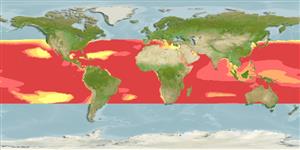
marin pelagic-oceanic; océanodrome (Ref. 51243); profondeur 0 - 1 m (Ref. 122940). Subtropical; 43°N - 34°S
Subtropical waters of all oceans. Eastern Atlantic: occasional to Spain and English Channel, western Mediterranean (a separate population migrates to the southeastern part in winter), Portugal to Mauritania and from south of Namibia; also off the Cape, South Africa (Ref. 2797). Possibly in Ascension I. (Ref. 98447). Western Atlantic: Massachusetts, USA and Bermuda to southern Brazil (Ref. 7251). Northwest Atlantic: Canada (Ref. 5951).
Taille / Poids / Âge
Maturité: Lm ? range ? - ? cm
Max length : 30.0 cm TL mâle / non sexé; (Ref. 7251); common length : 20.0 cm TL mâle / non sexé; (Ref. 3397)
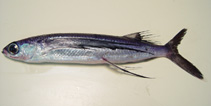
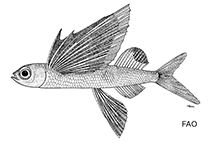
Épines dorsales (Total) : 0; Rayons mous dorsaux (Total) : 10 - 12; Épines anales: 0; Rayons mous anaux: 10 - 13; Vertèbres: 45 - 47. This species is distinguished by the following characters: elongated body is nearly rectangular in cross-section, almost flat ventrally, its depth 6.2 to 7.9 times in standard length (SL); 45-47 vertebrae; 25-30 predorsal scales; scales in transverse row 6 to 7.5, usually 6.5; the head 4.2-5.2 times in SL: eye 3.1-3.3 times in head; subequal jaws; jaw teeth conspicuous, conical; no palatine teeth; gill rakers on first arch 25-31; dorsal fin low, with 10-12 rays; anal fin with 10-13 rays, originating slightly before, or 1-2 rays behind dorsal-fin origin; pectoral fins 1.3-1.4 times in SL and with 16-18 rays, first 2 rays unbranched; pelvic fins 2.8-3.4 times in SL, inserted slightly nearer to posterior margin of opercle than origin of caudal fin base: juveniles without barbel (Ref. 109257). Colour of body dark, iridescent blue above, silvery white below; dorsal and caudal fins greyish, other fins hyaline (Ref. 2797); pectoral fins black without unpigmented cross-band and with a narrow light outer margin; pelvic fins usually without black spot (Ref. 109257); juveniles elongate, paired fins black (Ref. 2797).
Body shape (shape guide): elongated; Cross section: angular.
Inhabits oceanic surface waters. Capable of leaping out of the water and gliding for considerable distances above the surface (Ref. 3720). Feeds on zooplankton (Ref. 109257). Eggs with bunch of filaments opposed by a single filament on opposite pole (Ref. 6523). Reported to have no importance to fisheries (Ref. 109257). Depth assumed from ecology data.
Cycle de vie et comportement reproducteur
Maturité | Reproduction | Frai | Œufs | Fécondité | Larves
Carpenter, K.E. and N. De Angelis (eds.), 2016. The living marine resources of the Eastern Central Atlantic. Vol. 3: Bony fishes part 1 (Elopiformes to Scorpaeniformes). FAO Species Identification Guide for Fishery Purposes, Rome, FAO. pp. 1511-2350. (Ref. 109257)
Statut dans la liste rouge de l'IUCN (Ref. 130435: Version 2025-2 (Global))
Menace pour l'homme
Harmless
Utilisations par l'homme
Pêcheries: commercial
Outils
Articles particuliers
Télécharger en XML
Sources Internet
Estimations basées sur des modèles
Température préférée (Réf.
123201): 15.2 - 27.8, mean 24.5 °C (based on 1598 cells).
Indice de diversité phylogénétique (Réf.
82804): PD
50 = 0.5002 [Uniqueness, from 0.5 = low to 2.0 = high].
Bayesian length-weight: a=0.00646 (0.00293 - 0.01422), b=3.04 (2.85 - 3.23), in cm total length, based on LWR estimates for this (Sub)family-body shape (Ref.
93245).
Niveau trophique (Réf.
69278): 3.0 ±0.1 se; based on size and trophs of closest relatives
Résilience (Réf.
120179): Haut, temps minimum de doublement de population inférieur à 15 mois (Preliminary K or Fecundity.).
Vulnérabilité de la pêche (Ref.
59153): Low vulnerability (20 of 100).
🛈
Nutriments (Ref.
124155): Calcium = 330 [106, 676] mg/100g; Iron = 2.03 [0.91, 4.71] mg/100g; Protein = 18 [16, 20] %; Omega3 = 0.254 [0.100, 0.741] g/100g; Selenium = 11.3 [4.2, 31.0] μg/100g; VitaminA = 18.8 [4.8, 87.1] μg/100g; Zinc = 1.01 [0.62, 1.68] mg/100g (wet weight);