>
Ovalentaria/misc (Various families in series Ovalentaria) >
Opistognathidae (Jawfishes)
Etymology: Opistognathus: Greek, opisthe = behind + Greek, gnathos = jaw (Ref. 45335); to the very elongate upper jaw of the type species of the genus, Opistognathus nigromarginatus (Ref. 128653); castelnaui: Named for the French diplomat and ichthyologist Francis-Louis de Castelnau (1812-1880).
Eponymy: Francis(co) Louis Nompar de Caumont, Comte de Laporte de Castelnau (1810–1880) was a career diplomat and naturalist who was born in London, studied natural science in Paris, and then led a French scientific expedition to study the lakes of Canada, [...] (Ref. 128868), visit book page.
More on author: Bleeker.
Environnement : milieu / zone climatique / profondeur / gamme de distribution
Écologie
marin démersal; profondeur 20 - 100 m (Ref. 559). Tropical
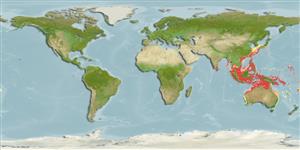
Indo-West Pacific: eastern Australia to the Ryukyus, Taiwan, Philippines, Malaysia, and Indonesia.
Taille / Poids / Âge
Maturité: Lm ? range ? - ? cm
Max length : 25.0 cm SL mâle / non sexé; (Ref. 559)
Description synthétique
Clés d'identification | Morphologie | Morphométrie
Épines dorsales (Total) : 11; Rayons mous dorsaux (Total) : 14; Épines anales: 3; Rayons mous anaux: 14; Vertèbres: 28. This species is distinguished by the following characters: elongated supramaxilla and posterior end of maxilla produced as a thin flexible lamina; upper jaw's inner lining and adjacent membranes with one or two conspicuous black stripes; dorsal half of dorsal fin usually dark except for narrow pale margin, remainder of fin pale and often with 8 or 9 evenly spaced dark blotches that extend onto basal fourth to third of fin and slightly onto dorsum; D XI,14; body with about 90-11 0 oblique scale rows; total gill rakers 28-35 (Ref. 81517).
Body shape (shape guide): elongated; Cross section: oval.
Inhabits open sand and rubble substrates in about 20-25 meters (Ref. 48637). May be found in depths greater than 100 m (Ref. 559). Mouthbrooders (Ref. 240).
Cycle de vie et comportement reproducteur
Maturité | Reproduction | Frai | Œufs | Fécondité | Larves
Employ mouthbrooding to care for their young (Ref. 240).
Smith-Vaniz, W.F., 2023. Review of Indo-West Pacific jawfishes (Opistognathus: Opistognathidae), with descriptions of 18 new species. Zootaxa 5252(1):1-180. (Ref. 128653)
Statut dans la liste rouge de l'IUCN (Ref. 130435: Version 2025-2 (Global))
Menace pour l'homme
Harmless
Utilisations par l'homme
Outils
Articles particuliers
Télécharger en XML
Sources Internet
Estimations basées sur des modèles
Température préférée (Réf.
123201): 24.1 - 28.5, mean 27.5 °C (based on 554 cells).
Indice de diversité phylogénétique (Réf.
82804): PD
50 = 0.5000 [Uniqueness, from 0.5 = low to 2.0 = high].
Bayesian length-weight: a=0.00389 (0.00180 - 0.00842), b=3.12 (2.94 - 3.30), in cm total length, based on all LWR estimates for this body shape (Ref.
93245).
Niveau trophique (Réf.
69278): 3.7 ±0.6 se; based on size and trophs of closest relatives
Vulnérabilité de la pêche (Ref.
59153): Low vulnerability (21 of 100).
🛈