>
Beloniformes (Needle fishes) >
Exocoetidae (Flyingfishes)
Etymology: Parexocoetus: Greek, para in the side of + Greek, exos = outside + Greek, koite = hole (Ref. 45335).
More on author: Richardson.
Ambiente: milieu / zona climática / intervalo de profundidade / gama de distribuição
Ecologia
marinhas pelagic-neritic; oceanódromo (Ref. 51243); intervalo de profundidade 0 - 20 m. Subtropical; 37°N - 35°S, 34°E -
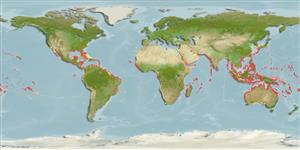
Western Atlantic: northeastern Florida, USA and the Bahamas to Brazil (Ref. 7251); common in Caribbean Sea and Lesser Antilles area; less common in the Gulf of Mexico, the Gulf Stream and the western Sargasso Sea (Ref. 3720). Eastern Atlantic: Guinea to Angola (Ref. 4498). Indo-Pacific: widespread from East Africa, including the Red Sea (Ref. 26165) to southern Japan, Hawaii, the Marquesas, and Queensland (Australia); separate population in the eastern tropical Pacific (Bay of Panama).
Comprimento na primeira maturidade / Tamanho / Peso / Idade
Maturidade: Lm 12.0, range 11 - 13 cm
Max length : 20.0 cm TL macho/indeterminado; (Ref. 5217); common length : 16.0 cm TL macho/indeterminado; (Ref. 5217)
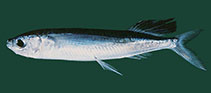
Espinhos dorsais (total) : 0; Raios dorsais moles (total) : 12 - 14; Espinhos anais: 0; Raios anais moles: 12 - 14. Body iridescent greenish blue dorsally, silvery white ventrally; dorsal black except for base and posterior rays which are pale; pelvic fins greyish, other fins transparent (Ref. 2797).
Body shape (shape guide): elongated.
Occurs in coastal waters (Ref. 9300), rare in the open ocean (Ref. 9839). Capable of leaping out of the water and gliding for considerable distances above the surface. 3-4 individuals aggregate during breeding (Ref. 47825). Carnivorous (Ref. 9137). Not important as food fish, but occasionally taken by fisheries.
During breeding, a spawning aggregation composed at least of 3-4 individuals, probably 2-3 males to 1 female, were observed jumping and flying over the water surface, exuding ripe eggs and sperm in the process.
Spawning on surface substrate (e.g. flotsam) when present is the usual reproductive mode but other modes may be employed if this substrate is not available. The fertilised eggs may remain suspended in the water surface during its development with the help of the small filaments on the egg surface and the adhesive filaments holding the egg mass together, by increasing the surface to volume ratio of the eggs, which aids in propping the eggs up in the water column. The eggs may also be suspended upon current or become benthic.
Parin, N.V., 1996. On the species composition of flying fishes (Exocoetidae) in the West-Central part of tropical Pacific. J. Ichthyol. 36(5):357-364. (Ref. 27313)
Categoria na Lista Vermelha da IUCN (Ref. 130435: Version 2025-2 (Global))
Ameaça para o homem
Harmless
Utilização humana
Pescarias: pouco comercial
Ferramentas
Relatórios especiais
Descarregue XML
Fontes da internet
Estimativas baseadas em modelos
Temperatura preferida (Ref.
123201): 23.3 - 29.2, mean 27.8 °C (based on 4764 cells).
Índice de diversidade filogenética (Ref.
82804): PD
50 = 0.6250 [Uniqueness, from 0.5 = low to 2.0 = high].
Bayesian length-weight: a=0.00646 (0.00293 - 0.01422), b=3.04 (2.85 - 3.23), in cm total length, based on LWR estimates for this (Sub)family-body shape (Ref.
93245).
Nível Trófico (Ref.
69278): 3.4 ±0.45 se; based on food items.
Resiliência (Ref.
120179): Elevada, tempo mínimo de duplicação da população menor que 15 meses (Preliminary K or Fecundity.).
Vulnerabilidade da pesca (Ref.
59153): Low vulnerability (10 of 100).
🛈
Nutrientes (Ref.
124155): Calcium = 479 [160, 1,136] mg/100g; Iron = 3.29 [1.39, 7.43] mg/100g; Protein = 17.6 [15.4, 19.7] %; Omega3 = 0.339 [0.115, 1.121] g/100g; Selenium = 32.4 [11.1, 88.9] μg/100g; VitaminA = 9 [2, 49] μg/100g; Zinc = 1.45 [0.85, 2.51] mg/100g (wet weight);